

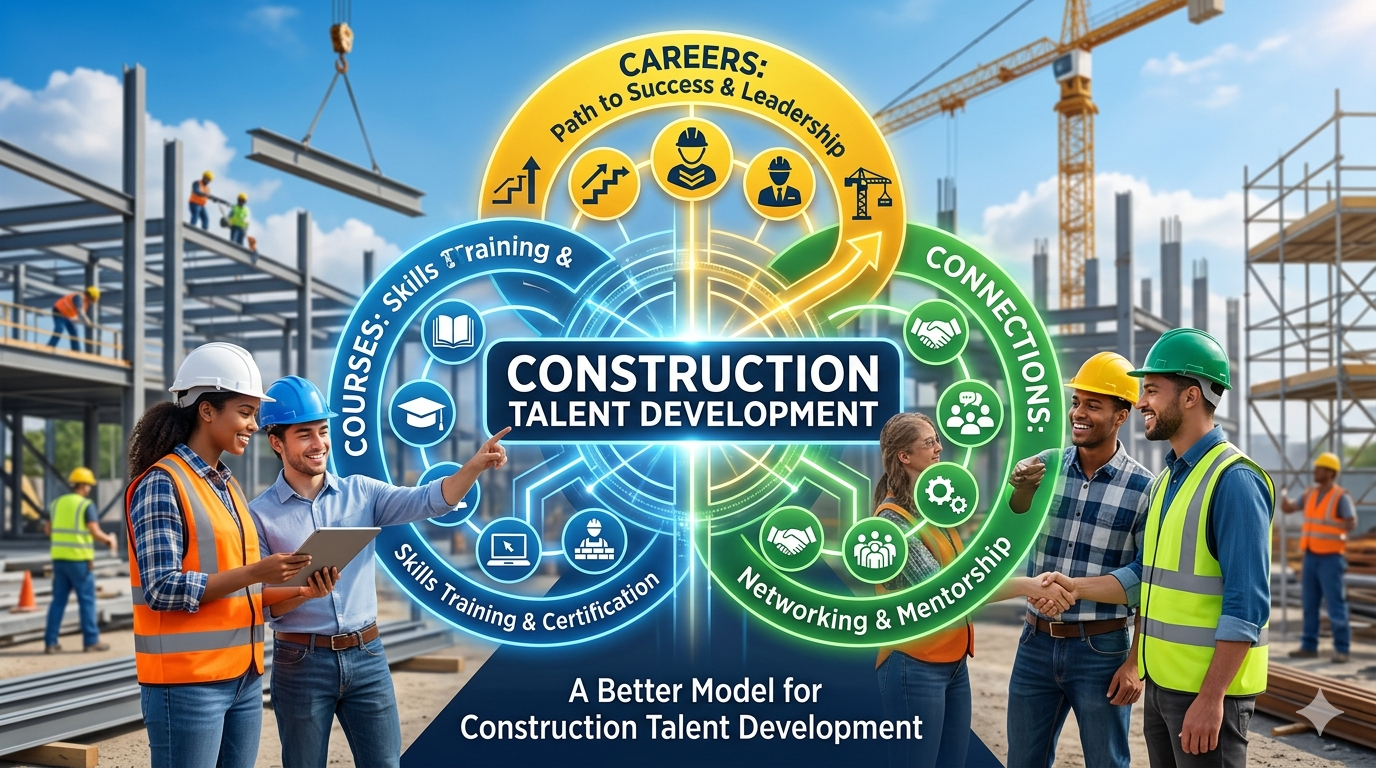
Currently, there’s a construction talent development bottleneck in the construction industry. Today, the traditional apprenticeship framework just can’t keep up with both the incredible pace of digitalisation and changes in workforce expectations. The global construction industry is projected to require approximately 500,000 new workers by late 2026 to meet surging infrastructure and housing demands, yet industry-wide turnover rates have climbed as high as 68%.
This talent gap is truly a structural problem that originated from disconnected educational curricula, career progression and networking activities. What we really need is “Courses, Careers & Connections”- an integrated framework where construction talent development is looked at as a seamless, technology-driven life-cycle process.
The Fragmented State of Construction Workforce Pathways
Today, the landscape of construction talent development has turned into the “skills-experience” paradox, which has impacted the efficiency of operation and the potential for sustainable development in the construction industry. Educational institutions are more concerned with theory-based teaching, whereas the construction industry requires immediately available practical technical skills that cannot be obtained with “Courses” only.
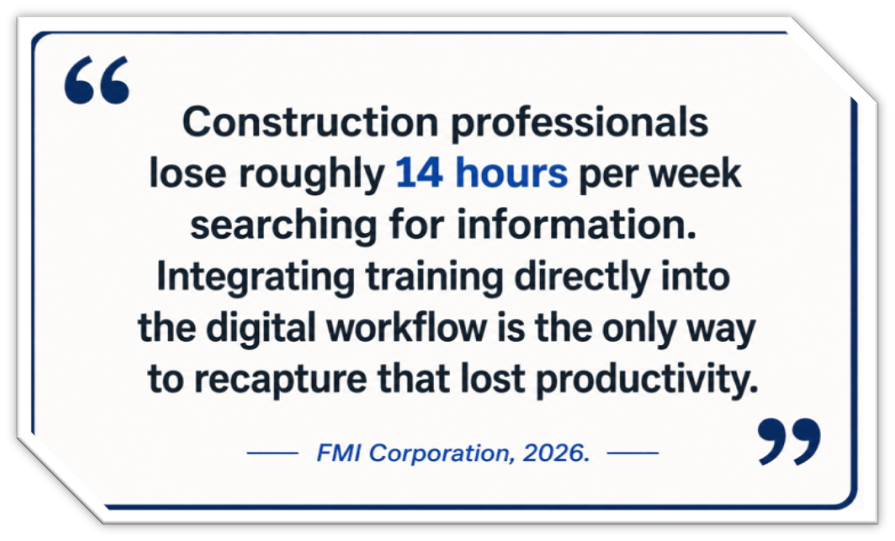
More than 35% of the total time (more than 14 hours a week) for construction professionals is spent looking for information and solving problems that result from having disconnected systems. This statistic comes from FMI Corporation. Poor project management and communication are responsible for 48% of all construction rework. The direct cost of reworking will occur on 4 to 6 per cent of the total budget, but if indirect costs are included, the total cost is approximately 9 per cent of the total project budget. A smooth transition between a student and a professional has failed due to the lack of a construction “Career” map of transformation of a labourer to a manager or technician to a digital strategist.
The Impact of a Disconnected Ecosystem
| Challenge Factor | 2026 Industry Impact | Economic Consequence |
| Labor Shortage | 500,000 vacant roles | Delayed project timelines by 4–6 months |
| Turnover Rate | 68% industry average | Replacement costs 20–213% of annual salary |
| Skills Evolution | 44% of core skills shifting | Widening digital gap in BIM and AI usage |
| Training Spend | 42% of firms increasing budget | Fragmented ROI due to lack of standard pathways |
A New Framework for Construction Talent Development
To meet the labour demands, we have to shift to a holistic approach in which we emphasise the “Three C’s”: Courses (upskilling), Careers (progression), and Connections (networking). This approach ensures that construction talent development is not just an HR checkbox but a core business strategy that evolves with the worker.
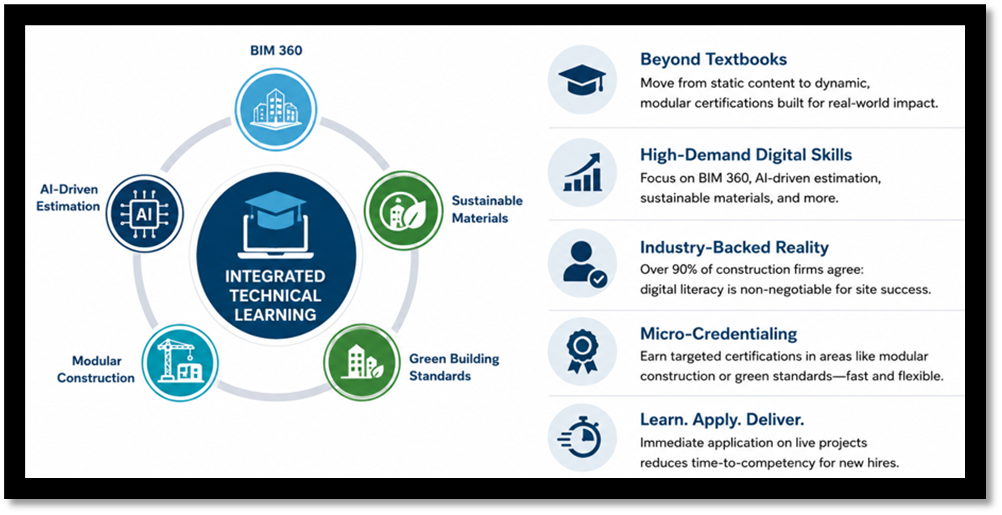
1. Integrated Technical Courses:
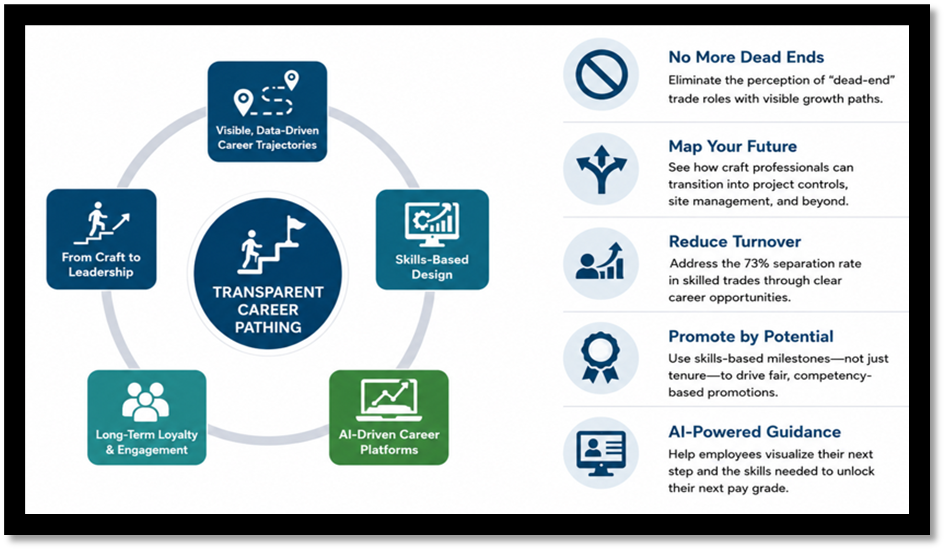
2. Transparent Career Pathing:
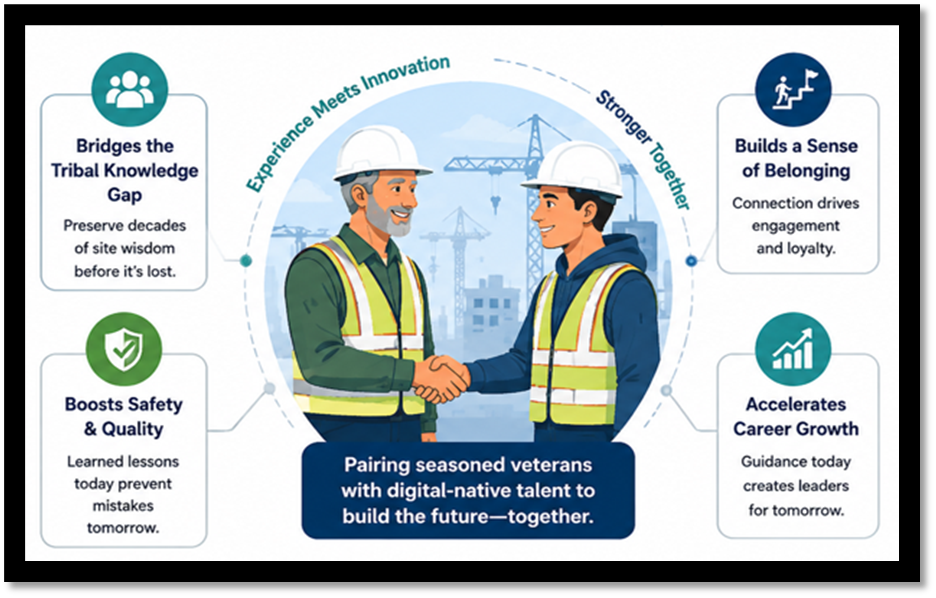
3. Mentorship and Professional Connections:
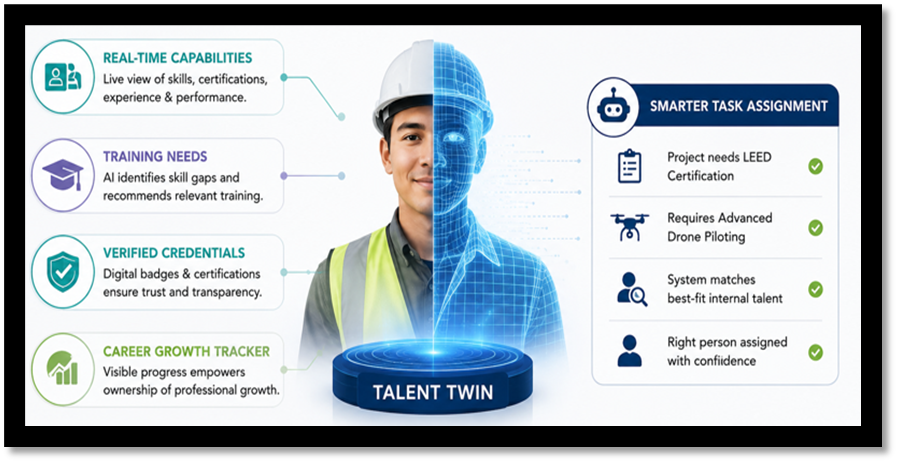
4. Digital Twins of Talent:
The Rise of Modular and Prefabricated Methodologies
As we transition to a more complex construction talent development model, we should not ignore the rapid acceleration of off-site manufacturing. Currently, data from Dodge Construction Network show that 27% of new construction undertaken in 2026 will utilise prefabricated elements, with that number expected to rise to 35% by the end of the decade.
This shift means that the workforce needs to be prepared for both the factory and the jobsite, and traditional craftsmanship needs to meet industrial engineering. When a construction talent development program integrates modular literacy, a construction company will be more prepared to take on the specific logistics required to execute an assembly line style of construction.
The Quantifiable Advantages of Off-Site Construction
Beyond weather delays, transitioning construction to the controlled environment of the factory transforms the quality and efficiency of construction projects. By training your crews on these processes under a contemporary construction talent development methodology, they learn to:
- Reduce Waste: Modular projects result in 50% less construction waste than on-site projects.
- Save Energy: These processes consume 67% less energy during the construction phase.
- Speed Up Projects: These processes reduce project delivery time by 30-50% by allowing for parallel construction processes.
- Lower Costs: Off-site projects have been shown to save 20% on total project costs on low-rise multi-family buildings.
- Optimise logistics: Construction traffic in a community is reduced by 56%.
Sector Adoption and the Global Opportunity Gap
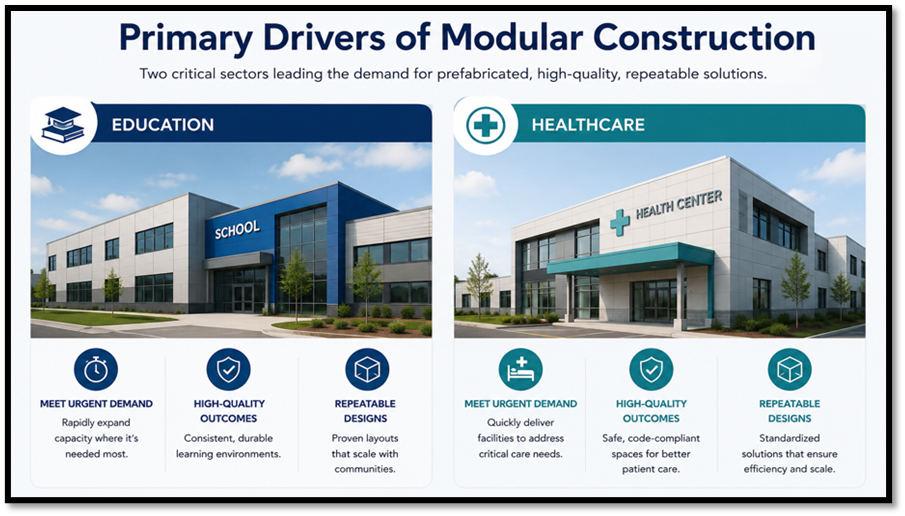
Education and healthcare currently account for much of this shift, with prefabricated buildings delivering the solution to immediate need through cost-effective, reproducible design. Geography, however, plays a considerable part in how we approach this skill set.
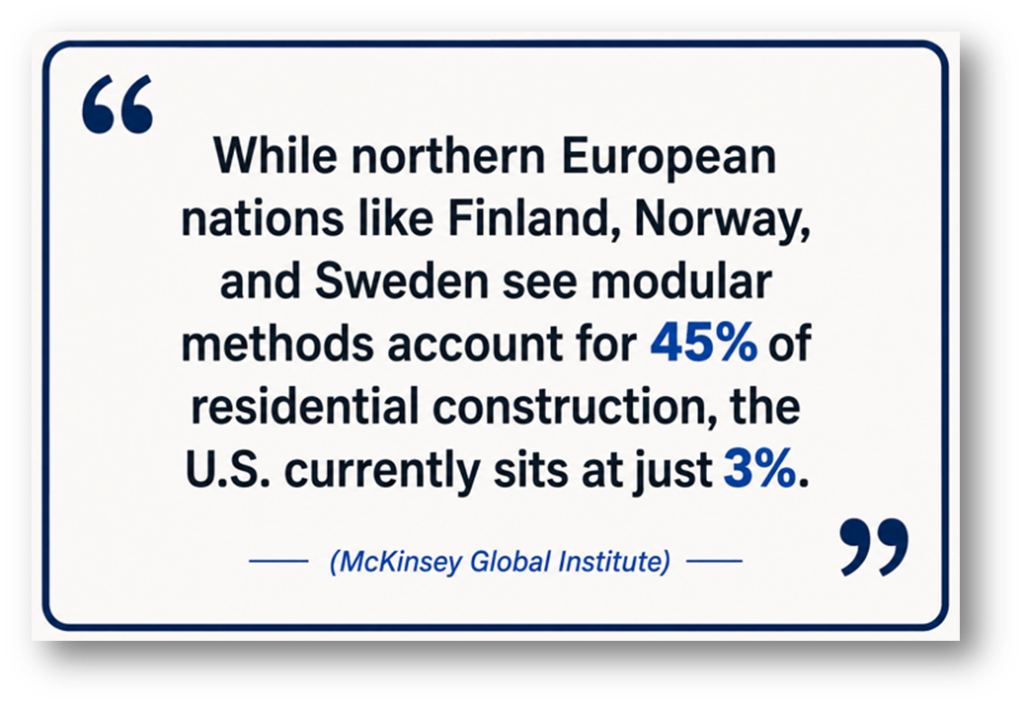
This gap represents a massive opportunity for forward-thinking contractors to invest in specialised training and prefab capabilities to capture an underserved market.
| Sector | Adoption Driver | Key Benefit |
| Education | Fluctuating enrollment | Rapid capacity expansion with zero campus disruption. |
| Healthcare | Urgent care needs | High-precision medical modules delivered in weeks. |
| Hospitality | Standardized ROI | Uniform room quality across global hotel chains. |
| Residential | Housing shortages | Scalable, cost-effective multi-family units. |
Strategic Shifts for 2026 and Beyond
This new construction talent development model requires an entirely new mindset toward investment in people within the firms. Offering a strong compensation package is no longer sufficient. The contemporary worker expects an entire environment conducive to their well-being as a professional.
- Buy vs. Build: Firms are foregoing the competition over scarce external talent by building out academies and internal processes to nurture their own specialists.
- AI in HR: HR departments are using AI to streamline job description creation and candidate evaluation for job skills compatibility, ensuring a human-in-the-loop process for final interviews.
- Focus on Soft Skills: With the assistance of digital tools, work is being increasingly done by technology in construction- and for that reason, skills such as stakeholder management, conflict management, and leadership are becoming the new ‘hard’ skills in the sector.
- Modular Workforce Planning: Borrowing talent for specific project components and maintaining an internal core ‘built’ workforce for culture and consistency is becoming a staple of construction talent development.
Implementing Active Talent Management
For the “Courses, Careers, and Connections” model to work, leadership must adopt a proactive rather than reactive stance toward their people. Construction talent development should be treated with the same rigour as project scheduling or cost control.
| Strategy Component | Implementation Action | Expected Outcome |
| Real-time Feedback | Use Pulse Surveys to identify turnover risks early. | 15–20% reduction in voluntary churn. |
| Skills Gap Analysis | Annual audit of digital vs. traditional skill sets. | Targeted training ROI and lower rework costs. |
| Cross-Functional Teams | Rotate office staff to the field and vice versa. | Better communication and holistic project understanding. |
| Incentivized Learning | Tie bonuses to the completion of high-demand “Courses”. | Accelerated adoption of new tech and standards. |
Final Thoughts
A “Courses, Careers, and Connections” approach offers a better way for an industry accustomed to and resigned to a perpetual shortage of skilled workers. Seeing construction talent development as an interconnected ecosystem and embracing this model, firms will be able to do away with the fractured processes that today drive away workers. Rather than simply filling seats, the “Courses, Careers, and Connections” model cultivates a pipeline of technically competent and digitally proficient individuals who are trained and prepared for 2026 and beyond.
Companies will emerge as leaders who recognise that their greatest asset is neither their equipment nor software nor the processes that govern them, but rather the people who operate the equipment and software and who implement the processes. Investing in a better construction talent development model is the only path to maintaining the industry as a feasible and desirable place to work.
Sources
- https://cicconstruction.com/blog/half-a-million-short-the-construction-workforce-crisis-reshaping-project-delivery/#:~:text=The%20Cost%20of%20Turnover,experiencing%20separation%20rates%20of%2073%25.
- https://premiercs.com/blog/construction-industry-trends-2026-what-every-project-manager-needs-to-know
- https://www.adp.com/spark/articles/2026/03/the-hr-trends-shaping-the-construction-industry-in-2026.aspx#:~:text=Construction%20HR%20leaders%20should%20review,resumes%20to%20reducing%20scheduling%20friction.
- https://www.deloitte.com/us/en/insights/industry/engineering-and-construction/ec-workforce-development-strategy.html
- https://www.autodesk.com/blogs/construction/2026-construction-trends-25-experts-share-insights/
- https://www.frontlinerecruitmentgroup.com/resources-hub/how-construction-firms-can-retain-talent-in-2026/

