

Construction skill development in India is at an inflexion point and undergoing a complete transformation, with digital technology fundamentally changing how employees, engineers, and project managers are upskilling. Pure classroom-based learning is giving way to integrated, adaptive and technology-based learning ecosystems.
India’s construction sector, among the largest employers, is now moving in step with globally recognised frameworks, the “future of work” initiative of the World Economic Forum. Policy guidance by NITI Aayog and a global labour perspective by ILO are speeding up a more systematic approach to skilling. Given the growth in infrastructure demand, there is now an urgent need for scalable, role-specific and mentor-based learning models.
Future of Construction Learning in India: Market Transformation and Skill Disruption
Learning in the construction industry in India is being transformed by fast urbanisation, megaprojects of infrastructure and the use of digital technologies, including BIM and AI-driven construction planning tools. Relying on the older apprentice model in on-site construction is not the only pathway. Rather, structured learning systems combining e-learning, classroom teaching and simulation-based case studies are evolving.
Employability-linked skill frameworks developed as per industry requirements are being promoted by bodies such as NITI Aayog, lifelong learning among construction workers is being stressed by the ILO globally, and the WEF future of work framework emphasises agility, digital proficiency and hybrid learning. By 2030, a massive number of construction workers in India will need to be re-skilled because of automation and green building. It’s not a choice; it is structural.
Core Learning Pillars in Construction Skilling
These five integrated learning dimensions are the bedrock for future construction learning in India, with each one contributing to changing how learning is accessed, experienced and applied on the actual construction site. Each of these dimensions involves a blend of technology and pedagogy that will ensure construction workers are well-trained and prepared to handle the demands of future construction work in the country.
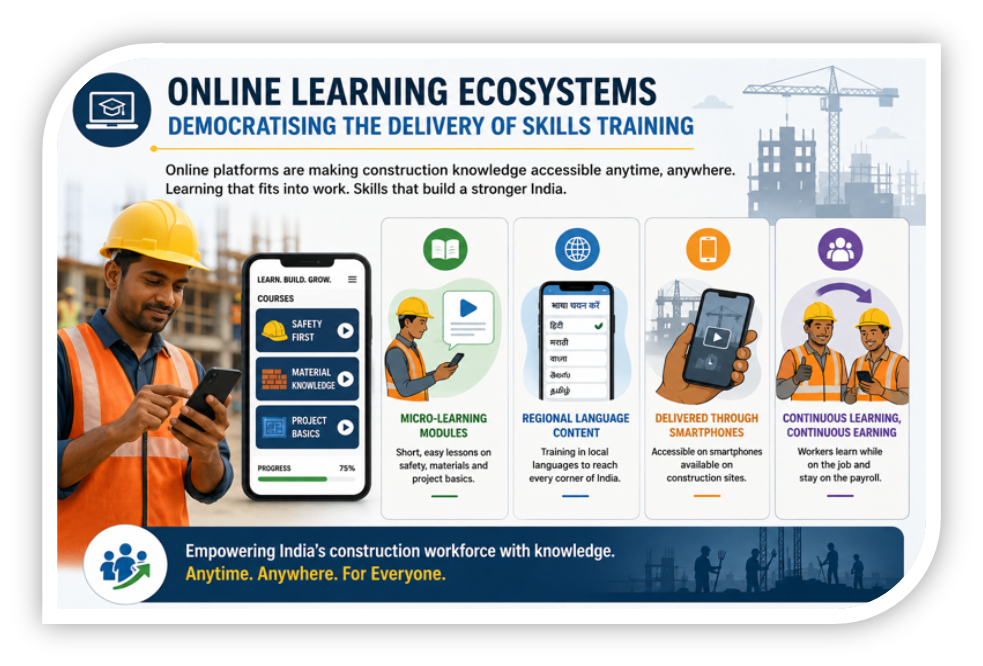
1. Online Learning Ecosystems: Democratising the Delivery of Skills Training
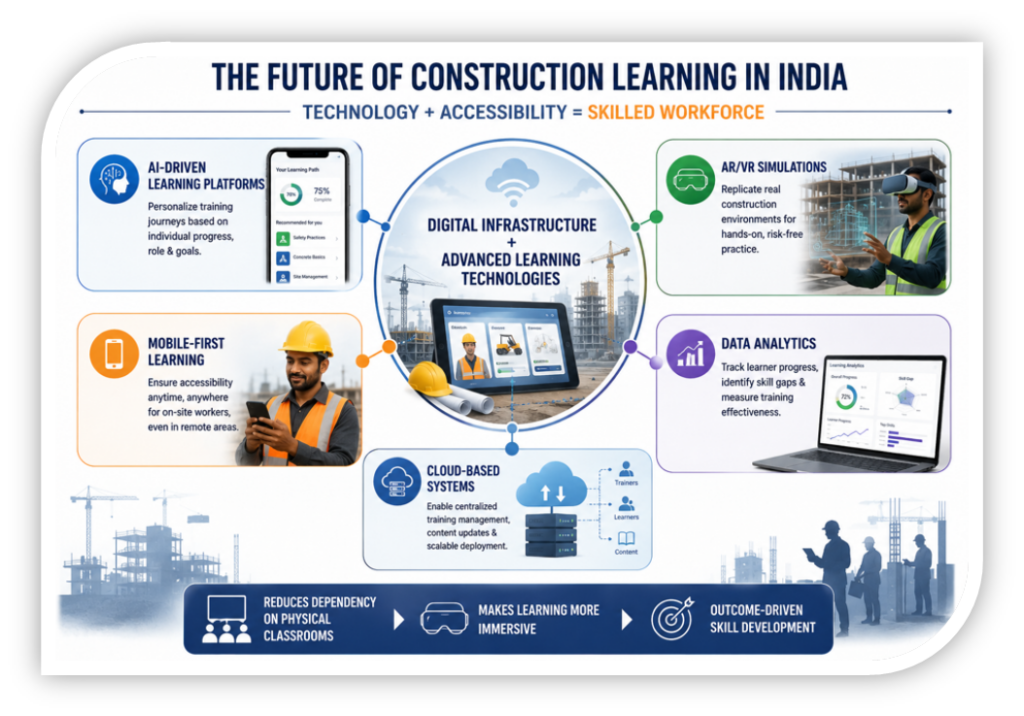
As an integral part of construction learning, online platforms are changing the way in which knowledge and information on construction skills are distributed across India. Online systems allow workers, engineers, and site supervisors to access construction information at their convenience, leveraging mobile-first solutions.
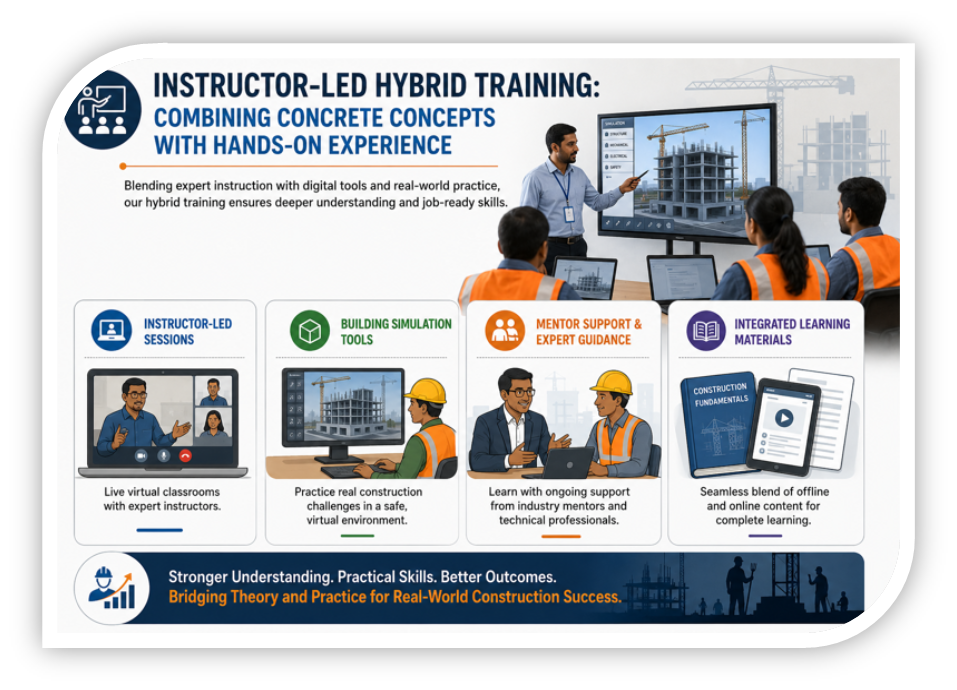
2. Instructor-Led Hybrid Training: Combining Concrete Concepts with Hands-on Experience
The delivery of training on instruction-led hybrid modules combines aspects of traditional classroom instruction with the benefits of online resources, simulators and virtual training. It ensures that learners not only achieve theoretical expertise, but also obtain practical application of learning.
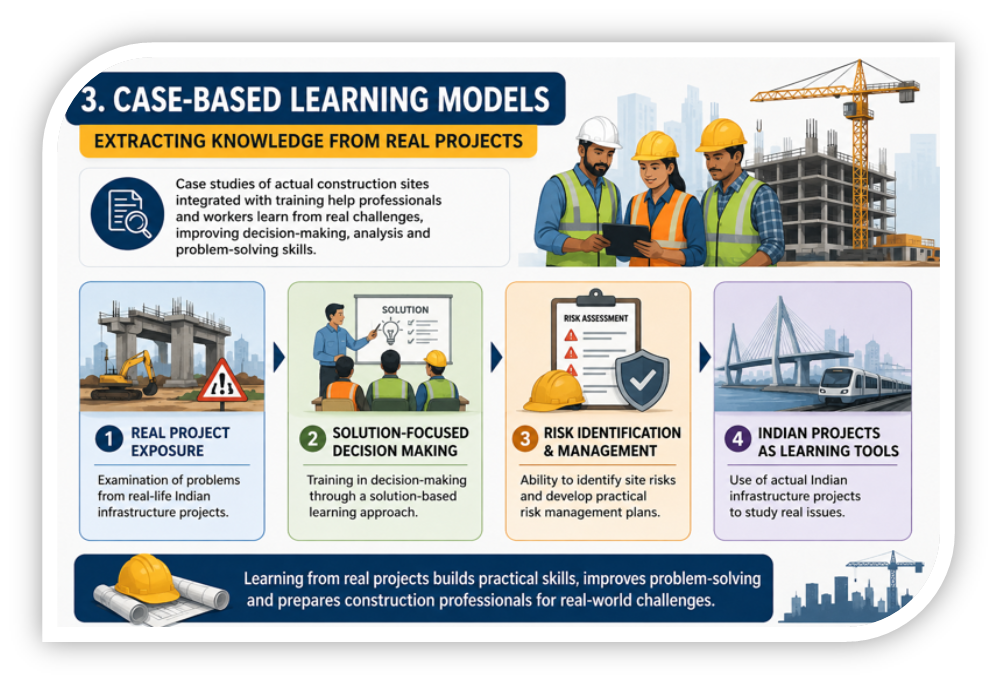
3. Case-Based Learning Models: Extracting Knowledge from Real Projects
Case studies of actual construction sites offer an invaluable learning experience by integrating them with training courses for construction professionals and labourers. Issues that affect cost overruns, scheduling delays, safety shortcomings, or poor design execution, among others, are studied in detail to improve the practical learning of decision making, critical analysis and problem solving.
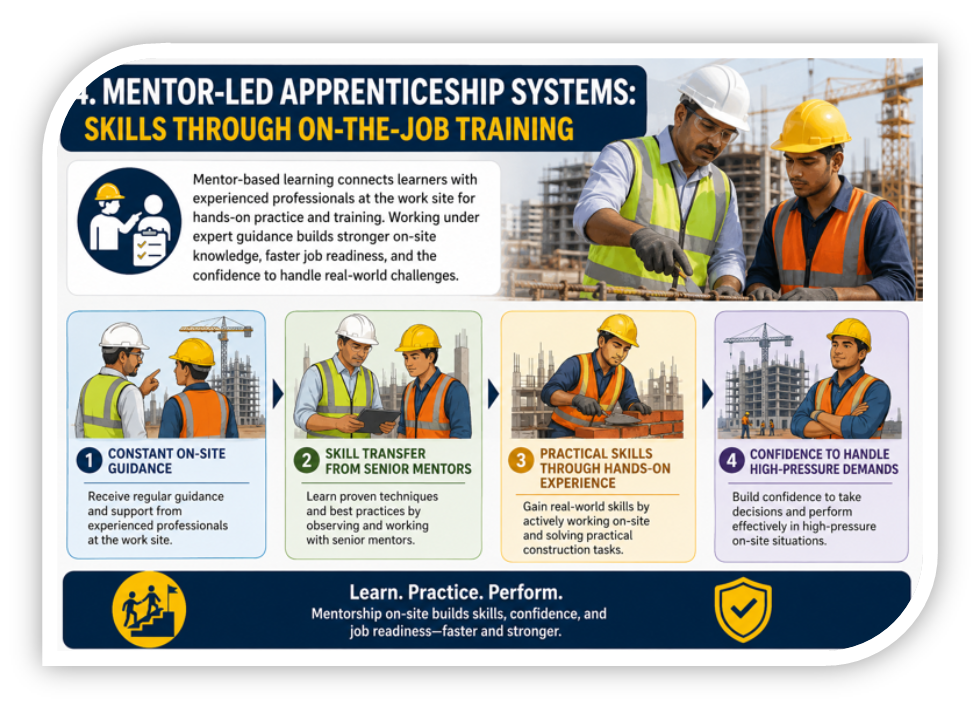
4. Mentor-Led Apprenticeship Systems: Skills Through On-the-job Training
Mentor-based learning requires the presence of experienced professionals at the work site who will be responsible for developing a knowledge transfer program for learners through on-site practice and training. In essence, learners get an opportunity to work under experienced hands, so that their on-site knowledge becomes stronger and work-ready at a quicker pace compared to purely classroom learning environments.
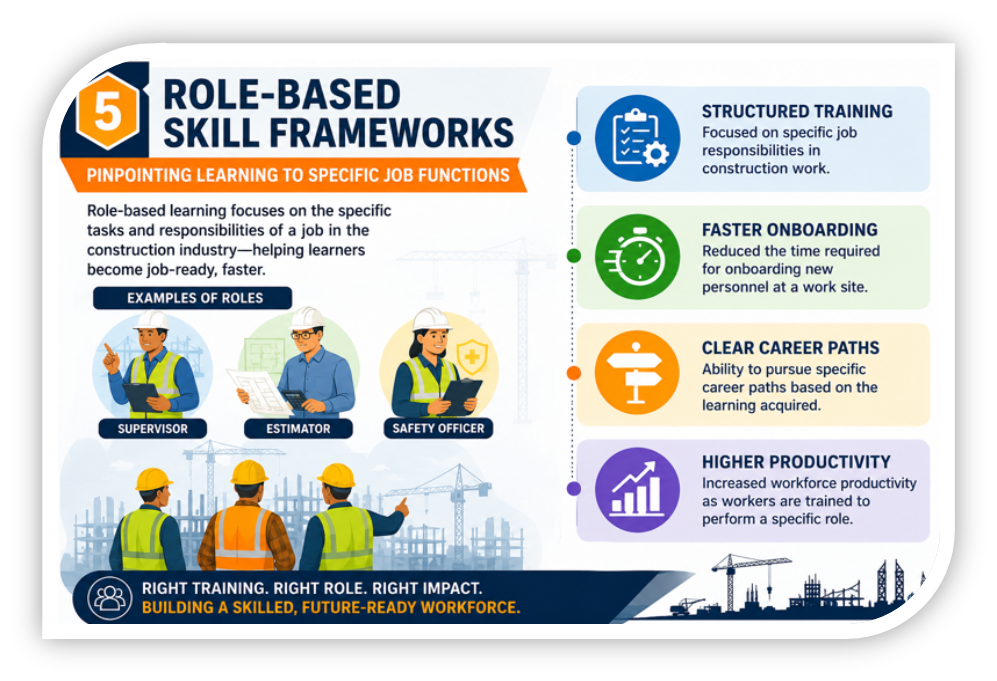
5. Role-Based Skill Frameworks: Pinpointing Learning to Specific Job Functions
Rather than focusing on general skill acquisition, role-based learning allows individual learners to be trained on specific tasks and duties as part of defined roles in the construction industry. Whether they will take on the responsibilities of a supervisor, estimator, or safety officer, their learning will be geared towards excelling in their particular position.
Technology Integration and Digital Learning Infrastructure
Skills Demand vs Supply in the Construction Sector
| Skill Category | Current Demand | Training Availability | Gap Level |
| Digital Construction (BIM, CAD) | High | Medium | High |
| Safety Management | Very High | High | Medium |
| Green Construction | Rising | Low | Very High |
| Project Management | High | Medium | High |
| Equipment Automation | Rising | Low | High |
The future of construction learning in India must address these gaps through structured and scalable interventions. Without alignment between demand and supply, productivity losses will continue to widen.
Integrating Models with Policy Frameworks
Blending these elevates the future of construction learning in India, supported by NITI Aayog’s SDE Division and ILO’s skilling roadmaps. WEF’s report calls for tech infusion across value chains.
- NITI Aayog Initiatives: State Support Missions and Universal Skill Passport standardise credentials, embedding online and role-based elements.
- ILO Alignment: Focus on apprenticeships merges instructor-led with mentor-led for equitable access.
- WEF Future-of-Work Lens: Emphasises case-based for agility amid BIM and drones.
- Challenges: Digital divide; solutions include hybrid hubs in aspirational districts.
- Metrics for Success: Track via KPIs like placement rates (target 80%) and productivity gains.
| Learning Model | Key Strength | Policy Tie-In | Projected Impact |
| Online | Accessibility | NITI ITI Reforms | 50% cost reduction |
| Instructor-Led | Hands-On | ILO Apprenticeships | 30% retention boost |
| Case-Based | Analysis | WEF Scenarios | 25% error reduction |
| Mentor-Led | Personalization | NITI SDE | 2x career acceleration |
| Role-Based | Simulation | WEF Tech Adoption | 90% engagement |
Impact on Workforce Productivity and Employability
The future of construction learning in India is expected to significantly improve productivity, reduce project delays, and enhance workforce employability across skill levels.
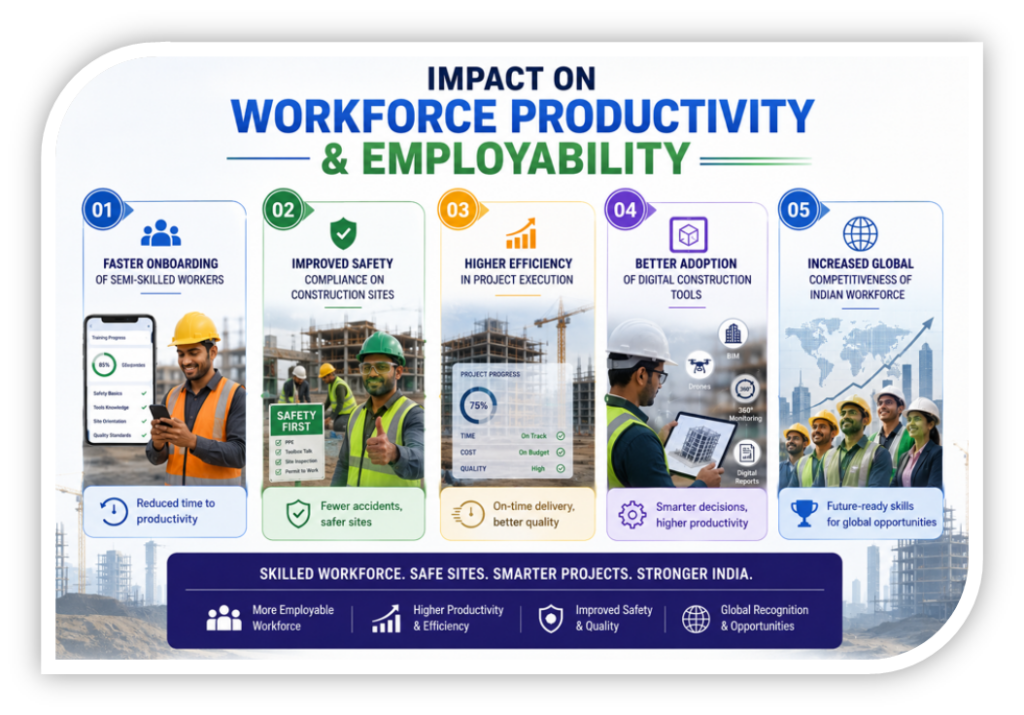
Skills Evolution Forecast
Digital Skills Demand Growth (2025–2035)
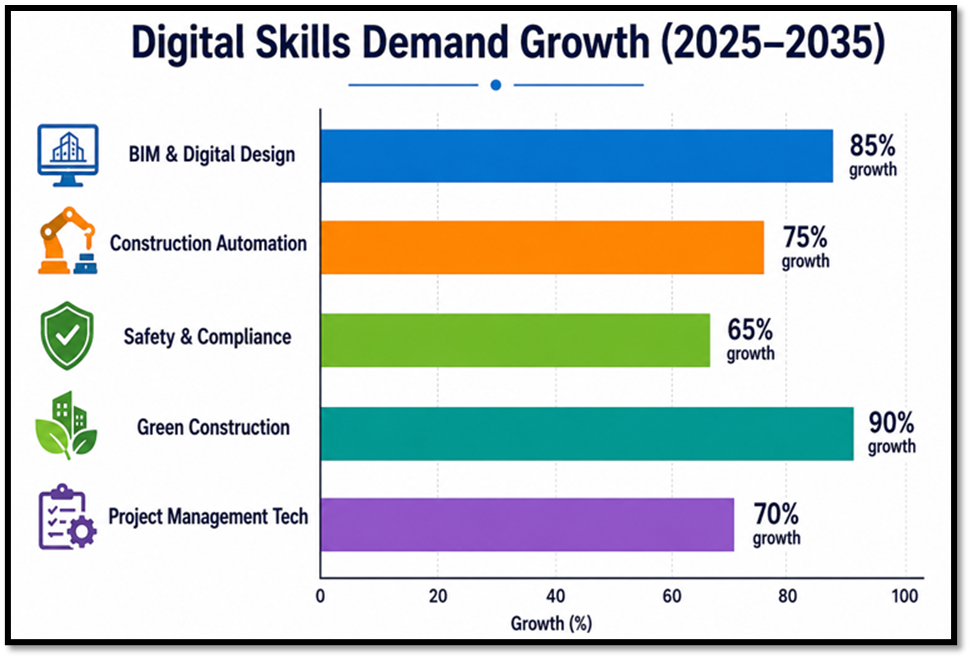
This trajectory reinforces the importance of continuous learning systems in the construction sector.
Challenges in Scaling Construction Skilling
Despite strong momentum, several challenges persist in scaling the future of construction learning in India.
- Limited digital infrastructure in rural areas.
- Low awareness among informal workers.
- Fragmented training ecosystem.
- Quality inconsistency in skill delivery.
- Lack of standardised certification systems
Addressing these challenges requires coordinated efforts between government, industry, and education providers.
Strategic Recommendations for the Next Decade
To fully realise the potential of the future of construction learning in India, a structured roadmap is required:
- Develop national digital skill platforms for construction.
- Integrate AR/VR into mainstream training modules.
- Strengthen public-private partnerships for skilling.
- Build standardised certification frameworks.
- Expand mentor-led apprenticeship networks.
These interventions will ensure sustainable workforce transformation.
Final Thoughts
The transformation of construction education is not merely a training update. It’s a structural overhaul in how India is moulding its future workforce. The inclusion of digital portals, mentorship networks, and competency-based learning is revolutionising employability. Aligned with international guidelines, policies ensure enduring stability. The increasing demand for infrastructure, as a consequence, makes training a critical factor in driving productivity and creativity. Already in effect, the reform will shape India’s competitive advantage in construction for years.
Sources
- chrome-extension://efaidnbmnnnibpcajpcglclefindmkaj/https://www.niti.gov.in/sites/default/files/2023-02/ITI_Report_02022023_0.pdf
- https://www3.weforum.org/docs/WEF_Shaping_the_Future_of_Construction_full_report__.pdf
- https://www.ciob.org/blog/core-construction-skills-explained
- https://ldca.on.ca/blogpost/1535025/511114/Build-Your-Future-Essential-Skills-for-Construction-Leaders-2025-2030
- https://www.researchgate.net/publication/270109343_Core_Elements_of_Construction_Engineering_Knowledge_for_Project_and_Career_Success

