


Industry-linked learning in construction has been acknowledged as one of the most effective ways for education systems to connect with the ever-changing workforce demands. For a sector like construction that is multifaceted, fragmented and project-oriented, the distance between theory and practice in terms of the knowledge and skills required on the job has increased so much. Policy frameworks of organisations like the ILO and several skill development reports are unanimous in pointing out that traditional vocational training is no longer adequate to meet the demands of the labour market.
Employers are looking for job-ready candidates who are capable of working with digital tools, have an understanding of safety practices and latest construction methods from the first day. But unfortunately, most of the fresh graduates remain under-skilled to effectively contribute to the sector, resulting in supply-demand mismatch, project holdups and extra costs of training, etc. This blog is aimed at discussing how we can change the whole pre- and post-education working relationships through a well-organised learning spectrum, along with the employers.
The Widening Construction Skills Gap and Why Traditional Training Fails
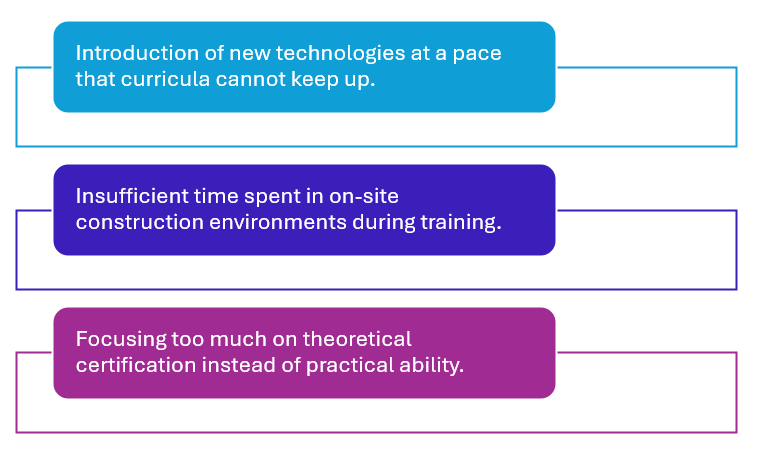
The global construction industry is undergoing a structural workforce challenge that cannot be resolved by updating curricula gradually. Industry-linked learning in construction has become a significant way to fill this gap, especially since the skilled labour shortfall is growing. Old training methods usually don’t change. They focus a lot on theory, and they are often far removed from the actual working conditions on the site. Graduates have a hard time moving from the classroom to the construction site because of this. Employers are still facing shortages for both technical and digital skills. The result has been a mismatch that caused inefficiencies in timelines, costs, and quality across projects.
Industry-linked learning in construction is the way forward because it remedies the present shortcomings of the system by coordinating what gets taught with the actual jobs available. The development of skills, without this coordination, stays piecemeal and reactive rather than well-planned and proactive.
Main causes behind the gap:
How Employer-Integrated Models Reshape Workforce Readiness
For industry-linked learning in construction to be a real engine of change in the pipeline from education to employment, it must become part of employer ecosystems, rather than being viewed as the external function of a mere academic institution. This necessitates that the training institutions, contractors, and policy-making bodies be brought together as partners who work in harmony with one another.
Basically, industry-linked learning in construction is about students not only acquiring knowledge through instructions but also actively experiencing the work through live projects, simulations, and working in the actual environment.
1. Apprenticeship-led Learning Pathways
Schools of thought on learning in the construction industry/craft highlight apprenticeships as the main source of industry-linked learning. They provide learners with well-planned time for being on a job site while certified at the same time. In contrast to traditional internships, apprenticeships are very long, well-ordered, and assessment of competencies is one of the features that determines the duration.
2. Employer-designed Curriculum Frameworks
One of the most crucial aspects of linking industry with learning for the construction sector is the joint development of the curriculum by both industry and educational institutions. Employers play a significant role in setting skill benchmarks through project-based scenarios, thus making the education relevant and up-to-date with the latest changes. This approach not only shortens the time gap between new technologies and what is being taught but also ensures that the students or workers learn the equipment and methods that are actually being used in the field. These curriculum frameworks lead to a significant enhancement in employability and job performance.
3. On-site Learning and Live Project Exposure
In fact, the very best ways of linking learning with real work in the construction industry are to be found in giving the students direct contact with ongoing projects. In this way, the students come to understand the realities of coping with various limitations such as strict times, financial restrictions, safety rules, and material management. The knowledge gained in this manner leads to the acquisition of skills that are not possible to develop through classroom-type lessons only. Besides this, it empowers the learners to be resourceful in situations where the project or the requirements are changing unexpectedly. From their side, employers mention an increase in effectiveness or output of the workers who have been given the opportunity to undergo such exposure.
4. Digital Construction and BIM Integration
Industry-linked learning in construction that is modern needs to view digital fluency as a core skill. Software such as BIM (Building Information Modelling), digital twins, and project management are some of the digital tools which have become standard in large-scale projects. Training programs which incorporate these tools from the start help to lessen the digital divide among workers. Besides, such preparation makes learners ready for the global construction markets where digital coordination is a prerequisite.
5. Continuous Feedback Loops Between Employers and Educators
Reliable industry-linked learning in construction systems is dependent on continuous feedback mechanisms. Employers regularly inform training providers about the new skills that they see are lacking through real projects performed by their workers. This way, the content of education and training can be changed more in line with what is happening in the world rather than based on ancient academic revision cycles. Feedback also contributes to the improvement of certification standards and examination procedures.
Policy Frameworks and Global Benchmarks Driving Change
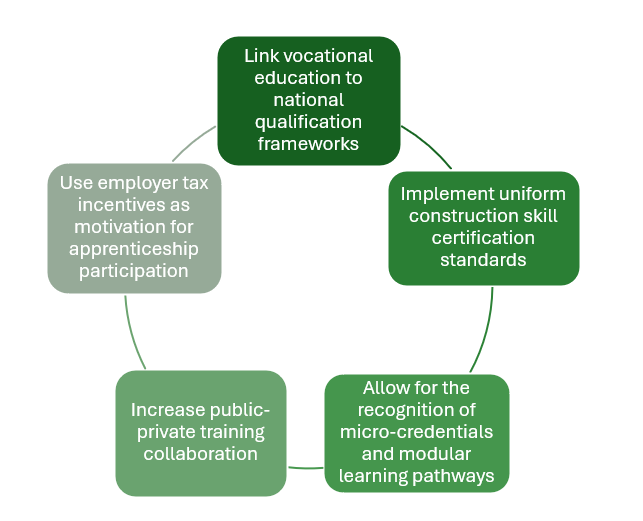
Construction-related industry-linked learning is fast becoming a focal point for global policy makers and employer associations. Issues such as job mismatch and skills gap have been identified by ILO and national councils as two main concerns the construction sector faces. However, the construction sector also happens to be one of the largest job creators.
Integration of industry-linked learning into national workforce strategies in the construction sector can significantly boost employability and productivity. The government, through various measures such as subsidies, certification frameworks and public-private partnerships encourage employer participation. Such a move is part of a larger realisation that skills development alone is not enough without considering the demand of industries.
The Role of Platforms in Scaling Industry-linked Learning Ecosystems
Online platforms are playing a pivotal role in expanding industry-linked learning in construction in fragmented markets. These platforms serve as mediators between students, employers, and training providers. They not only facilitate the alignment of talent with up-to-date project requirements but also keep a record of skill development.
Generally, a contemporary industry-linked learning in construction platform combines features like job matching, certification tracking, and skill analytics. Through this, it brings clarity to the whole learning-to-employment process and minimises the wastage of resources due to disparate training environments.
Platform-Enabled Transformation Model
| Layer | Function | Impact |
| Learning Layer | Skill development modules | Standardized competency building |
| Exposure Layer | Live projects & apprenticeships | Real-world experience |
| Matching Layer | Employer-job alignment | Faster hiring cycles |
| Analytics Layer | Skill gap tracking | Continuous improvement |
Through this model, industry-linked learning in construction becomes scalable, data-driven, and outcome-oriented rather than purely academic.
Employer Trends Redefining Construction Workforce Expectations
The expectations of employers are changing quickly, and as a result, they are changing the requirements for the design of industry-linked learning in construction at an accelerated pace. Construction companies do not consider only manual skill proficiency anymore; they have started to give more importance to digital literacy, problem-solving ability, and adaptability, among others.
Nowadays, employers tend to look for candidates trained through industry-linked learning in construction who can show the following expected capabilities:
- Ability to work with digital project management tools.
- Understanding of sustainability and green construction practices.
- Familiarity with safety compliance frameworks.
- Strong communication across multidisciplinary teams.
- Capacity to adapt to fast-changing project environments.
These expectations are directly influencing how training programs are structured globally.
Why Industry-Linked Learning is a Competitive Advantage and Not Just a Policy Tool
Besides policy and education reform, companies in the construction sector that take part in industry-linked learning are also gaining a competitive edge. Businesses that tender to create well-organised talent pipelines through structured learning programs bring down their hiring expenditure, increase employee retention, and contribute to better project performance.
Construction industry-linked learning is setting employer branding on firmer ground and thereby making the business more desirable to fresh talent. In the current very lean labour market, this upside can indeed be of critical strategic importance. The companies that do not devote any effort to these structured learning ecosystems are, with no doubt, going to be less productive and less innovative as well.
- Less onboarding and training expenses.
- More employee retention.
- Better project completion times.
- A closer meeting of skills demand and supply.
- Greater creativity brought about by talent pipelines of highly skilled workers.
Digital Transformation, AI and Construction Learning Ecosystems
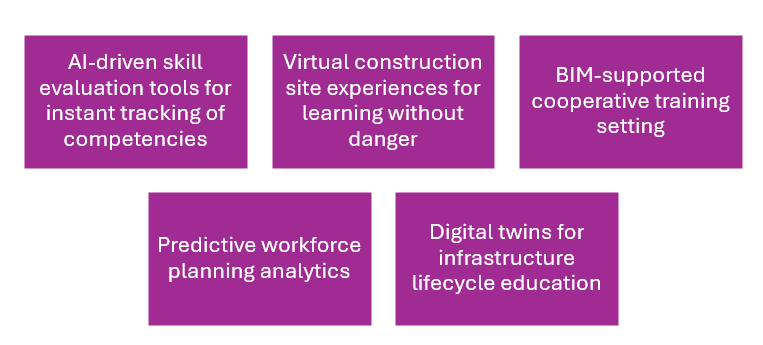
Technological upheaval is leading the next wave of changes in the workforce, and industry-linked learning in construction is playing a major role in this transformation. As the construction sector relies more on data, AI-based project planning, predictive maintenance, drones, and digital twins are changing the ways that workers function throughout the work process. Old-fashioned education programs cannot support this change unless they are part of actual digital environments.
In order for Industry-linked learning in construction not to lose its significance, learners should get familiar with simulation-based environments and AI-assisted decision-making tools right at the beginning of their training phase. This makes sure that the learners are not only job-ready but also future-ready. Hiring managers have already started to look for prospective employees who are capable of analysing data dashboards, using BIM tools, and working together on cloud-based project platforms.
Major facilitators of digital learning integration:
| Technology | Learning Application | Workforce Impact |
| AI Models | Skill gap detection | Faster upskilling |
| BIM Systems | Project simulation | Better coordination |
| IoT Devices | Site monitoring training | Safety improvement |
Within this framework, Industry-linked learning in construction would function as a living organism in a constant state of flux rather than a rigid curriculum. It would be continuously shaped by technological change cycles. The more deeply the ecosystem is interwoven, the quicker the workers are able to adjust to industry upheavals. In the end, digital transformation makes it possible for Industry-linked learning in construction not merely to respond to changes but to foretell and prepare for the talents required in the future.
Financing and Public–Private Collaboration Models Enabling Scalable Training
One of the most significant obstacles to scaling Industry-linked learning in construction is not a mere alignment of concepts but the financial sustainability aspect. Training infrastructure, digital tools, and apprenticeship programs call for joint investments from the public and private sectors that are well-coordinated. Without structured financing models, even well-designed systems could not scale effectively.
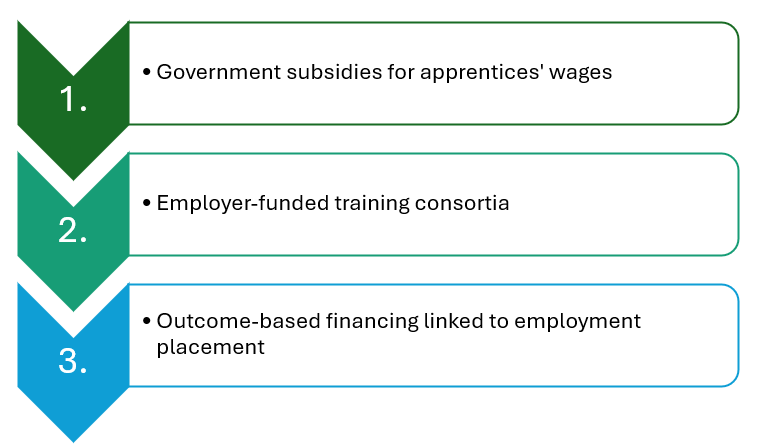
Governments, employers, and multilateral institutions are looking for new ways to fund Industry-linked learning in construction ecosystems. They are experimenting with hybrid models that include subsidy-driven apprenticeships, employer co-investment programs, and outcome-based financing mechanisms.
The main funding systems in place are:
Public–Private Collaboration Model
| Stakeholder | Role | Contribution |
| Government | Policy + subsidies | Regulatory support |
| Employers | Training + placements | Real-world exposure |
| Institutions | Curriculum delivery | Academic structure |
| Platforms | Matching + tracking | System integration |
Industry-linked learning in construction flourishes most when the financial risk is shared among the different stakeholders instead of being hoarded by a single entity. The hiring costs of employers are lowered, whereas governments get to reduce the number of unemployed. Learners, on the other hand, improve their employability. This shared-value model of industry-linked learning through construction is what makes it sustainable.
Besides, industry-linked learning in construction manages to attract international development funding as a direct means of employment, improvement of productivity, and efficiency of infrastructure. Training systems change from being cost centres to investment engines only when financing is tied to outcomes.
A Practical Roadmap for Implementing Industry-Linked Learning at Scale
Growth of Industry-linked learning in the construction sector not only needs a change in the policy but also a detailed plan of implementation, which will bring together educational institutions, employers and the use of technology. Even though different countries have been able to develop skill frameworks, they have not always been able to produce the right mechanisms for their successful implementation. Therefore, a well-thought-out plan or roadmap will create a demonstration of the possibility of the planned activities, allow a means of comparison and give a basis for measuring progress.
One way to plan for Industry-linked learning in the construction sector is to structure it through four stages: design, integration, deployment, and optimisation.
Phase 1: System Design and Stakeholder Alignment
System design and stakeholder engagement mean planning and developing a system that will allow us to identify the skills the construction industry requires and incorporate them into the learning objectives. It is the responsibility of the employers to create competency frameworks, and training providers have to understand them and develop modular training programs. Without such a coordinated effort, Industry-linked learning in the construction sector may become disjointed and ineffective.
Phase 2: Curriculum and Platform Integration
Learning modules are, at this point, combined with digital platforms and also aligned with the workflows of the employer. Craft structures are delineated, and learners are sent to live construction sites for work. By so doing, Industry-linked learning in the construction sector becomes part of the actual industry processes.
Phase 3: Large-scale Deployment
Programs are introduced widely with regional standardised assessment frameworks. Employers are quite involved in the evaluations, making sure that skill measurement standardisation is maintained. This phase enables the practical implementation of Industry-linked learning in construction on a large scale.
Phase 4: Continuous Optimisation
Communication channels are created among employers, learners, and training providers. They utilize data analytics to enhance curriculum content, uncover skill gaps, and raise placement efficiency.
Key success factors:
- Extensive employer involvement in curriculum development.
- Digital tools for instant skill monitoring.
- Uniform competency-based evaluations.
- Regulatory encouragement for apprenticeship growth.
- Ongoing data-based curricular revisions.
In essence, industry-linked learning in construction, in fact, is nothing less than a living system that changes and adapts according to what the industry needs. Instead of an intervention, it is a never-ending cycle of creating better and improving. Countries and companies that will manage, with this roadmap, to implement it successfully will be able not only to reduce skill mismatches but also to increase construction productivity.
Final Thoughts
Industry-linked learning in construction has changed drastically, and its evolution marks the key change in the education systems being isolated from the work-integrated ecosystems. Since the construction is becoming more digital, global, and complicated, the demand for organised employer involvement in learning will increase in direct relation to the ongoing development in the construction industry.
The ILO and the major industry organisations have reiterated that achieving a trained sustainable workforce necessitates working together rather than going separate ways. The tools that will help education and employment align in real-time will be the hallmark of the next construction industry’s productivity. So, in the end, industry-linked learning in construction is not just a reform of education. It is a new way of structuring how the industry’s future workforce is being built.
FAQs
1. What is industry-linked learning in construction?
Industry-linked learning in construction is a method of training where formal education is combined with work experience in the field. It makes sure that students not only gain the knowledge but also get hands-on practice. This results in a better preparation for the work and enhanced employability in the construction sector.
2. Why is industry-linked learning important for construction?
It helps integrate theoretical studies with the skills needed on-site. Industry-linked learning in construction is instrumental in minimising skills gaps and elevating the level of output. Additionally, it aids in the quick adjustment of newly hired personnel.
3. How does industry-linked learning benefit employers?
Companies are able to hire workers who are already familiar with the trade and have been involved in real projects for a while. Industry-linked learning in construction cuts down on the time and money spent on initial training of workers, and it also maximises their performance. Moreover, it enables firms to create a solid pipeline of future talent.
4. What role does technology play in industry-linked learning?
Tech tools allow trainees to be engaged in simulations, use digital construction methods, and track skills. Industry-linked learning in construction is also heavily dependent on BIM and other project management solutions, which makes it more effective. It gives the learners a better insight into the workshop of the future.
5. Can industry-linked learning improve global construction standards?
It does match education to international top practices and competency frameworks. Industry-linked learning in construction standardises the skill sets worldwide, thereby enhancing the overall quality and safety in international construction projects.
Sources
- https://www.litmos.com/blog/articles/construction-industry-learning-and-development
- https://acr-journal.com/article/enhancing-construction-workforce-efficiency-through-digital-training-an-empirical-study-1568/
- https://www.sciencedirect.com/science/article/pii/S2352710221011578
- https://www.researchgate.net/publication/236154545_TRAINING_AND_DEVELOPMENT_OF_WORKFORCES_IN_CONSTRUCTION_INDUSTRY
- https://www.researchgate.net/publication/317799570_The_Role_of_Industry_Based_Learning_in_a_Construction_Management_Program
- https://www.autodesk.com/blogs/construction/continuous-learning-construction/

