

Currently, the global built environment is experiencing a period of “polycrisis,” which is characterised by labour shortages, material volatility and urgent need for decarbonisation. The traditional “wait and see” approach in technology that has worked well for many years in this sector will now be replaced by a “digitise or risk extinction” culture over the next 5 years. Therefore, it is no longer enough for construction professionals to passively watch the evolution of new technologies. They must proactively adapt and change how they do their jobs to remain professionally relevant.
The World Economic Forum’s Future of Jobs Report indicates that the construction industry will undergo one of the largest “skill churns” within an industrial sector. With generative AI automating routine estimates, scheduling, and administration, there will be a growing need for construction professionals to evolve from being task-oriented performers to data-informed strategists in order to remain professionally relevant. Construction professionals must now focus more on providing complex problem-solving, ethical oversight, and cross-functional functionality than on performing tasks.
The Core Pillars of Construction Career Relevance
A comprehensive knowledge of multiple disparate trends (AI, digital workflow, sustainability) will allow for a comprehensive overview of how they connect with one another, providing a modern project life cycle. According to the Autodesk 2024 State of Design and Make report, firms that focus on digital transformation are 1.6x more likely to outperform other companies. From an individual perspective, your market value is synonymous with your digital fluency.
1. Generative AI and Augmented Intelligence
AI isn’t stealing your job. It’s stealing your spreadsheets. Over the next five years, AI will be your co-pilot in construction. Large language models use 1000s of construction tender docs to identify risk, while ML algorithms use predictive analytics to anticipate safety hazards on site prior to their occurrence. AI is the new baseline. To stay relevant in the construction profession, you’ll need to learn how to prompt, audit, and manage these AI tools instead of pushing back against them.
2. Digital Workflows and the BIM Evolution
BIM has grown from being solely a 3D tool to a multi-dimensional information platform. Professionals who are skilled in 4D time, 5D cost, and 6D sustainability will see their career relevance in construction grow exponentially. Mastering how to work in a CDE (Common Data Environment) is now a prerequisite for those looking to hold a leadership position on infra projects.
3. The Sustainability and ESG Imperative
Decarbonization is not the “nice to have” in the professional portfolio anymore. With the recommendations to FIDIC based on more invasive carbon guidance and the recent regional requirements like the Green Deal of the EU and the NITI Aayog in India, every project is a carbon project. To be relevant in the construction career, you must master Life Cycle Assessments, embodied carbon accounting and circular economy.
4. Advanced Project Controls and Risk Mitigation
Project success is increasingly determined by the “quiet” functions of project controls. In an era of high interest rates and thin margins, the ability to provide real-time cost forecasting and automated progress tracking is vital. Enhancing your construction career relevance involves mastering tools that integrate field data (via drones or IoT) directly into financial dashboards.
5. Mastering the New Contractual Landscape
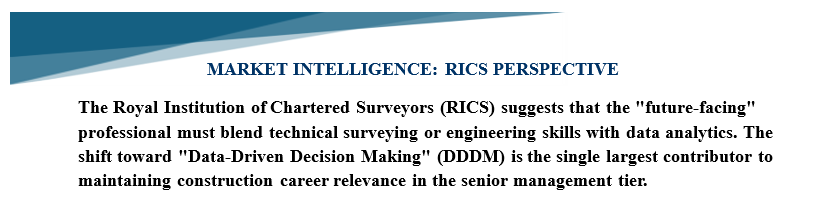
Understanding how digital twins and AI outputs interface with legal liability is a burgeoning field. Professionals who can navigate the legal complexities of “Data Ownership” and “AI-generated Errors” will find a niche of high construction career relevance. This requires staying close to sector commentary from bodies like RICS and legal infrastructure experts.
The Human Element: Collaboration and Modern Contracts
Technology manages the data, but relationships must be handled by the professional. To make the transition to Integrated Project Delivery (IPD) and collaborative contract formats such as NEC4, there needs to be a change in thinking. There is a heavy reliance on “soft” skills within the industry for career relevance: negotiating, being empathetic, and managing numerous stakeholders.
Collaborating isn’t just something one does. It can be used as a risk-management tool. The professional who bridges the gap between an architect’s vision, the engineer’s limitations, and the client’s budget (using a digital twin) will have 100% construction career relevance regardless of market conditions.
Conclusion: The Path to Permanent Relevance
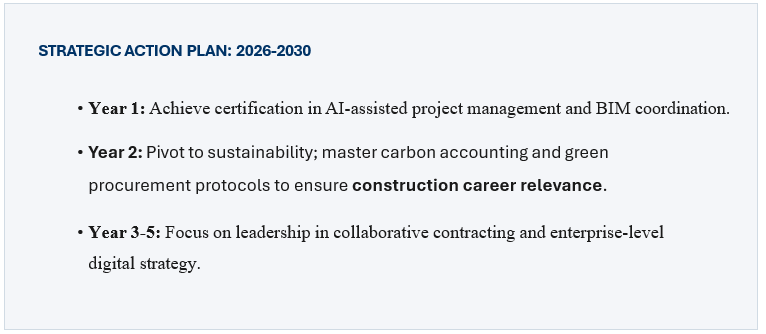
Over the next five years, the construction industry will experience a very high level of “creative destruction.” Many jobs will be gone, but many will also be created, including new roles like Digital Twin Managers, Carbon Auditors and AI Integration Specialists. How relevant you are in your construction career is based on your personal commitment to unlearning old ways of doing things as well as your ability to learn new ways.
When you combine AI-driven efficiency with a strong commitment to sustainability and a good understanding of project controls, you move from being a replaceable technician to an invaluable strategic partner. According to the World Economic Forum, “The Future is for Lifelong Learners”, so many will benefit from this approach in our industry. Lifelong learning will be the primary driver of construction career relevance.
As Autodesk, along with RICS leaders, has pointed out, the tools are available today, and all that is missing in their utilisation is the human person who is able to use those tools. Begin your transformation now to remain relevant in your construction career for the next decade.
Lastly, construction career relevance is about your resiliency as a professional. It is about who can produce Net Zero high-margin projects that employ advanced technology in an unpredictable environment for the next five years. That is your goal. Stay curious, stay digital, and stay relevant. The industry’s future is being built now. Ensure your construction career relevance by being the one who draws the blueprint.
Sources
- https://www.mckinsey.com/industries/engineering-construction-and-building-materials/our-insights/call-for-action-seizing-the-decarbonization-opportunity-in-construction
- https://www.researchgate.net/publication/384729499_AI-driven_decarbonization_of_buildings_Leveraging_predictive_analytics_and_automation_for_sustainable_energy_management
- https://www.sciencedirect.com/science/article/pii/S0926580525002420
- https://usbridge.com/why-construction-jobs-remain-a-low-risk-career-choice-in-the-age-of-ai/
- https://nationalskillsnetwork.in/how-ai-is-shaping-the-future-of-construction-through-skill-development/

