

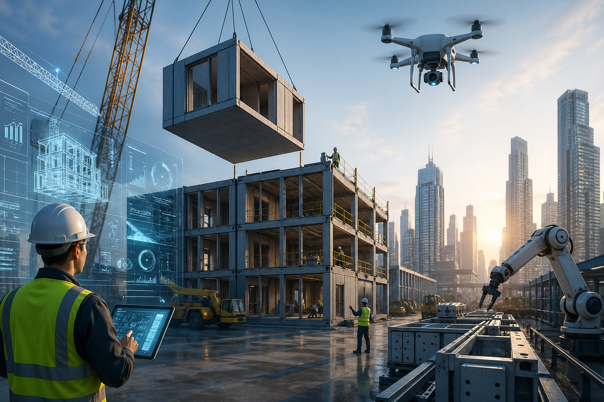
Industrialized construction is no longer a minor trend but rather becoming one of the main pillars of infrastructure development worldwide. Besides dealing with an escalating shortage of labour, the industry also has to manage pressure for greater sustainability. Such is the situation that many wonder whether the change is just a trend or a permanent shift in the way of building. Industrialized construction by treating the construction site similarly to a manufacturer’s floor provides a possibility of getting consistent results and meeting higher standards of quality.
This change is based on the use of technology to shift the most dangerous operations to controlled environments, thus mitigating the risks of the whole project. Leading companies like Autodesk are of the opinion that design and manufacturing are becoming so integrated that firms that neglect this convergence will no longer be competitive. In the end, moving to industrialized construction is a game-changer which will make the built environment more sustainable, data-driven, and efficient.
Why Industrialized Construction is Not Just a Fad
The industrialized construction’s main advantage, which has been the major reason for its permanent gaining of ground, is its ability to close the infamous “productivity gap” of the construction sector. Whereas with the conventional methods, there is always a risk of delays due to weather and other site-specific problems, this approach relies on the use of standard processes to secure uniformity. By combining automated manufacturing with BIM (Building Information Modelling), construction teams reach such a degree of accuracy that it is virtually impossible to imitate with manual field labour.
This uniformity results in considerably reduced material waste, which is a direct contribution to mitigating the environmental impact of the industry. At the same time, it leads to the improvement of the economy of the undertaking. As the worldwide demand for housing and infrastructure exceeds the currently available skilled workforce, the industrialized construction’s capability of mass production becomes a basic need of the structure of the industry and not a passing fashion.
Where Prefabrication and Modular Methods Actually Work
While the potential is vast, the success of industrialized construction depends heavily on the typology of the project and the level of repetition involved.
1. High-Repetition Residential Projects
The use of modular methods is very effective in such areas as multi-family housing, student housing, and hotels, where the floor plans are almost the same. Actually, industrialized construction gives rise to a “productisation” of the units that are factory-made and then assembled on the site.
This sort of repetition not only drives down the costs through economies of scale but also shortens the project timelines by a significant margin. By continuously refining one model, developers are able to make sure that each and every apartment has exactly the same top-notch features without having the variations that are usual in traditional site work.
2. Healthcare and Life Sciences Facilities
Medical establishments, due to their tightly packed site conditions, often find it very difficult to coordinate complicated MEP (Mechanical, Electrical, and Plumbing) systems. Industrialized construction permits the off-site building of components such as integrated headwalls, bathroom pods, or even entire lab modules. This first-hand the critical infrastructure implementation and validation before its arrival at the hospital site is a very impactful one. Besides, factory cleanliness is a lot easier to control and maintain, which is much more suitable for the precision that modern healthcare technology installations require.
3. Data Centres and Mission-Critical Infrastructure
With the demand for data storage continuously increasing, the quick delivery of services is a matter of survival for providers operating in this field. Industrialized construction allows the rapid manufacturing of standardised power and cooling modules that can be made and then simply plugged in anywhere in the world.
Thanks to such modularity, tech giants are capable of extending their physical presence from a matter of months rather than years, thus staying ahead of the competition. Also, as these projects are based on highly technical components, the approach of manufacturing-first makes it feasible to test and measure the specs accurately.
4. Educational and Standardised Public Buildings
Schools are usually constrained by smaller budgets and are severely limited in terms of construction time, which is usually allowed only during summer breaks. Industrialized construction not only dramatically reduces the construction time but also helps the majority of the building process to be done off-site while students are still in school.
When the school is out, the prefabricated modules are brought in and put together. This way, any inconvenience caused to the local community is practically non-existent. Since classrooms are standardised, the design of a modular classroom is a concept that is compatible with and adaptable to diverse school districts.
5. Remote or Logistically Challenging Sites
Construction in remote locations or heavily built-up city centres results in significant logistical problems, from bringing in workers to handling cramped work areas. Industrialized construction can help to overcome these problems by decreasing the volume of deliveries as well as the number of workers on the site.
The parts are made to be compatible with regular transport vehicles, and the assembly operation needs a much less significant “footprint” compared to a conventional staging yard. Thus, it is the most suitable method for sites where access is very limited or where local skilled labour is absent.
The Strategic Struggles of the Industrialized Model
There are definitely some tough challenges when shifting to an industrialized construction system, especially with regard to “front-loading” project efforts. In traditional construction, it is possible that the design might change during the construction phase. Whereas this concept needs the designers to be absolutely certain about their designs before the manufacturing phase can start.
1. Large Initial Investment: Usually, a large amount of money has to be spent very early in the project lifecycle for things like factory slots and bulk buying of materials.
2. Design Inflexibility: Making changes late in the process can be very costly and very disturbing if a component is already running through the manufacturing line.
3. Greater Logistical Challenge: Although it minimises site traffic, it leads to more complicated heavy-haul transportation and crane operations for large modules.
4. Cultural Resistance: Transitioning from a “project” to a “product” mentality is a huge change for architects and contractors in how they work together.
Comparative Analysis: Traditional vs. Industrialized
| Feature | Traditional Construction | Industralized Construction |
| Schedule Predictability | Low (Weather/Labor dependent) | High (Factory controlled) |
| Material Waste | High | Low |
| Design Changes | Possible during construction | Must be finalized pre-manufacturing |
| Labor Requirement | High on-site presence | Lower on-site, higher in-factory |
| Quality Control | Site-based inspections | Continuous automated QA/QC |
Which Roles Benefit Most from This Transformation?
The shift toward industrialized construction reshapes the professional landscape, creating new opportunities for specialised roles while demanding new skills from traditional ones.
1. The Role of the Digital Strategist and BIM Manager
Those engaged in the digital transformation of industries will view industrialized construction as a blessing since this mode of construction depends entirely on highly detailed data. BIM Managers change from mere coordinators to becoming the “glue” in the project, making sure that the digital twin that was developed in the design phase corresponds perfectly with the robots or CNC machines in the factory. Managing a complex digital supply chain becomes their new role.
2. Estimators and Preconstruction Leads
Estimators get more comfort with industrialized construction as they are dealing with costs of the product, which are known, rather than costs of labour and materials, which are volatile. So, it is more precise, and forecasting can be done in a better way, plus risk can also be mitigated. Preconstruction teams, on the other hand, can concentrate on the most efficient assembly sequence instead of always dealing with site-level changes and disruptions.
3. Sustainability and Environmental Consultants
The grid of industrialized construction will enable the economic tracking of carbon footprints and material lifecycles through the provision of data transparency. Environmental heads could partner with manufacturers to procure low-carbon materials right at the source to ensure that the constructed building adheres to Net Zero standards. The waste reduction and designing for “deconstruction” (circularity) are also the factors that make industrialisation of construction the preferred method for green-certified projects.
Final Thoughts
It’s quite evident that industrialized construction represents the future of a more efficient, sustainable, and predictable built environment. Although the move will require a big change in the way people invest and think, the advantages of less waste, quicker delivery, and better quality cannot be denied. The construction industry is progressively combining sophisticated manufacturing methods with digital design, and those who adopt these methods will be at the forefront of the global infrastructure of the next generation.
Sources
- https://www.epack.in/the-future-of-industrial-construction-in-india-peb-prefab-structures-explained?srsltid=AfmBOooYpldQUfZTE6TOWNE33M_LGySXMYkP7Jg5Kk8RDe0Sk1rMgEXY
- https://build-up.ec.europa.eu/en/resources-and-tools/publications/industrialised-construction-future-growing-population
- https://www.researchgate.net/publication/374916839_Industrialized_Construction_Megatrends_shaping_the_future_of_construction
- https://www.asce.org/education-and-events/explore-education/on-demand-webinars/industrialized-construction–revolutionizing-affordable-and-sustainable-housing

