

Nowadays, the global construction sector is no longer solely hinged on steel and concrete. It has evolved into an industry deeply concerned with matters such as carbon footprints and climate resilience. Architects, engineers, site managers, and consultants are amongst the professionals for whom sustainability has evolved from being a “niche” or peripheral interest to becoming a fundamental professional skill in their repertoire. In fact, according to the International Labour Organisation (ILO), shifting to a green economy plays a key role in creating new jobs and developing talent.
On those lines, Green Building and Decarbonization are set to be the career areas with the biggest potential of the decade, especially with the fast-growing urbanisation. This matches perfectly with the case of India, where the magnitude of the new infrastructure works to be launched is unparalleled.
The Macro Picture: Why Green Building and Decarbonization Matter Now
Recent NITI Aayog insights have revealed that the policy roadmap of India for its clean energy transition has been solidly laid down. Back in 2026, NITI Aayog published 11 reports detailing a strategy framework for various sectors like the transport industry, power, and buildings. The purpose of these reports is to guide the nation’s shift towards clean energy, balancing economic growth, and achieving the Net Zero target by 2070.
The main message to those in the construction field is straightforward: the edifices that we conceive today will shape the energy consumption pattern of the nation for the next fifty years.
The Scale of the Challenge (and Opportunity)
The information shared by NITI Aayog in the ‘Scenarios towards Viksit Bharat and Net Zero’ series reveals a shocking fact:
1. Future Growth: Nearly 86% of the total building floor area that will be there in 2070 is still to be built.
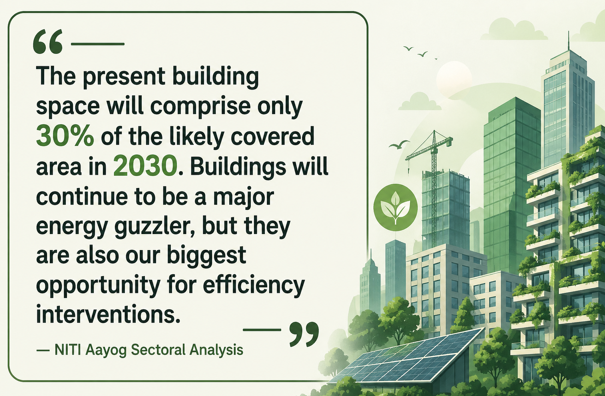
2. Energy Demand: At present, residential and commercial sectors consume 29% of the country’s electricity, and this figure goes up by 8% every year.
3. Cooling Needs: The number of people who own an air conditioner is expected to increase dramatically and will be more than 80% by 2070 from the existing 10%.
NITI Aayog CEO BVR Subrahmanyam said that buildings are not just one-time initiatives but long-term assets in communities, so construction activity should be carried out with Net Zero objectives in mind right from the beginning. For a professional, this implies that acquiring knowledge about Green Building and Decarbonization is not just a moral decision. It is a vital competency in an ever-changing market.
Technical Levers for Decarbonization
In order to translate lofty ideas into skills that will really help one’s career, the working people need to not only understand the “decisive levers” that have been pinpointed by NITI Aayog and the World Green Building Council (WGBC), but also know how to apply them. The idea of decarbonization in construction, for example, shouldn’t be limited to just installing solar panels. Rather, it should involve a comprehensive consideration of the entire building lifecycle.
1. Passive Design and Cooling
In a tropical climate, the cooling load is the primary energy driver. Professionals must shift toward:
- Orientation and Massing: Utilising natural shade and wind patterns.
- Thermal Envelope: Using high-performance insulation to reduce heat gain.
- Super-efficient Appliances: Integrating technology that minimises the energy required for ventilation and lighting.
2. Material Choices and Embodied Carbon
According to the World Green Building Council, “embodied carbon” refers to emissions of building materials’ manufacturing, transporting, and assembling. The total carbon footprint is a very large part of the building. Therefore, using low-carbon cement, recycled steel, and bio-based materials has become a technical approach.
3. Electrification and Bio-Energy
According to successive reports of NITI Aayog, electrification of energy and the use of Bio CNG are major strategies. Also, waste-to-energy system integration in big commercial buildings is one of the fastest-growing areas for MEP (Mechanical, Electrical, and Plumbing) engineers.
Strategic Framework: FIDIC and McKinsey Insights
Professionals who want to carry out Green Building and Decarbonization successfully should refer to global infrastructure standards. FIDIC (International Federation of Consulting Engineers) has issued a carbon handbook that indicates that the engineer’s role is as a “trusted advisor” in climate mitigation.
Also, according to McKinsey’s sustainability for infrastructure articles, the “value at stake” indeed is very high. Projects that neglect to integrate Green Building and Decarbonization measures at the planning stage are at risk of turning into “stranded assets” – properties that are too costly to run or will not be in line with future carbon taxes.
Key Consumption Drivers in Indian Buildings
| Category | Percentage of Total Consumption (India) | Projected Growth Rate |
| Residential/ Commercial Electricity | 29% | 8% Annually |
| Projected Floor Space (by 2070) | 86% yet to be built | Massive |
| AC Ownership (Current vs 2070) | 10% vs 80% | 8x Increase |
Making it Career-Relevant: Skills to Acquire
If you are a construction professional, how do you integrate Green Building and Decarbonization into your daily workflow? Here is the roadmap:
1. For Architects: Passive Design Mastery
Getting only the look of the buildings is not enough; you have to go beyond it. Using the software that helps you simulate thermal loads and solar gains is a good start. Green Building and Decarbonization should be one of your main considerations when you are planning the drawing board. If the building you design can remain naturally 5 degrees cooler, you have provided the client with value immediately.
2. For Civil & Structural Engineers: Low-Carbon Materials
Getting a deep knowledge of the “Circular Economy” is your mission. At the same time, you will need to figure out how fly-ash bricks, calcined clay, and recycled aggregates can be used without weakly affecting the structural strength. Besides materials and products, Green Building and Decarbonization include understanding the life cycle assessment (LCA) of materials.
3. For Project Managers: Carbon Accounting
Nowadays, alongside the financial budget, projects usually have to keep track of the “carbon budget” also. Take a look at FIDIC’s carbon guidance to help effectively monitor site emissions, waste reduction, and sustainable procurement.
4. For MEP Professionals: Energy Efficiency & On-site Renewables
There is a great demand-side energy savings potential in the Indian commercial sector. And there is a huge opportunity on the supply side as well if renewable energy generation is integrated into the buildings. Green Building and Decarbonization require you to be familiar with building automation systems (BAS).
The Economics of Sustainability
Many professionals hesitate because they fear that sustainability increases costs. However, the World Green Building Council points out that while upfront costs might be higher, the operational savings are immense.
By specialising in Green Building and Decarbonization, you position yourself as a professional who saves clients money over the 50-year lifespan of a building. This makes you a high-value asset in any firm.
Global Standards and Local Context
The objectives are worldwide, and the implementation of Green Building and Decarbonization needs to be local. According to the ILO, making the construction sector more environmentally friendly calls for a “Just Transition, ” meaning that workers should be trained for new skills and not laid off.
To integrate both modern technology (like HVAC systems driven by AI) and ancient knowledge (like passive cooling through courtyard and use of local stone) is one way in India. NITI Aayog’ s ‘Viksit Bharat’ document even shows the link between growth and care for the environment.
The Role of Renewable Energy in Buildings
- Solar PV Integration: Converting rooftops and facades into power plants.
- Solar Thermal: Using solar energy for water heating, which accounts for a significant portion of residential demand.
- Bio CNG & Waste-to-Energy: Implementing decentralised waste management systems in residential complexes.
Implementing these requires a workforce that views Green Building and Decarbonization as a multidisciplinary challenge.
Why You Can’t Wait
The regulatory scene is changing. Building standards will inevitably get tougher with the Net Zero 2070 goal. Experts who deeply grasp the concepts of Green Building and Decarbonization today will be the ones who write tender documents and are at the helm of firms in the future.
The McKinsey report on infrastructure sustainability notes that transforming the built environment towards zero carbon emissions ranks among the most economical approaches to meet climate objectives. Contrary to sectors like heavy industry or aviation that lack readiness, Green Building and Decarbonization can rely on existing technologies. What is needed are skilled professionals to carry out these initiatives.
Final Thoughts
Currently, we stand literally at a crossroads. As BVR Subrahmanyam pointed out, we are going to construct a volume of building on this planet so large that no other country in the world has reached that level of building activity. Basically, every square meter that we build continuously today will result in a carbon impact that will last for 50 years of the building’s life.
For a construction worker, adapting to the Green Building and Decarbonization trend is the best career change ever. It shifts your identity from a mere service provider to a solution architect. Apart from that, it makes your routine labour linked with the survival of Planet Earth and national economic prosperity.
Becoming an expert in Green Building and Decarbonization is not only about environmental preservation. In fact, it is a way to secure your career for the future as a professional in the globally most significant industry.
Sources
- https://economictimes.indiatimes.com/industry/renewables/niti-aayog-lays-out-a-blueprint-for-green-transition-across-key-sectors/articleshow/128165748.cms?utm
- https://www.energdive.com/news/electrification-of-energy-greening-the-energy-and-circularity-are-critical-for-net-zero-niti-aayog?utm
- https://www.pib.gov.in/PressReleasePage.aspx?PRID=2226683®=3&lang=2
- https://www.researchgate.net/publication/403002572_SECTORAL_INSIGHTS_BUILDINGS_SCENARIOS_TOWARDS_VIKSIT_BHARAT_AND_NET_ZERO
- https://worldgbc.org/article/the-business-case-for-green-building-a-review-of-the-costs-and-benefits-for-developers-investors-and-occupants/
- chrome-extension://efaidnbmnnnibpcajpcglclefindmkaj/https://www.niti.gov.in/sites/default/files/2025-07/Energy-Efficiency-Interventions-at-NITI-Aayog.pdf

