

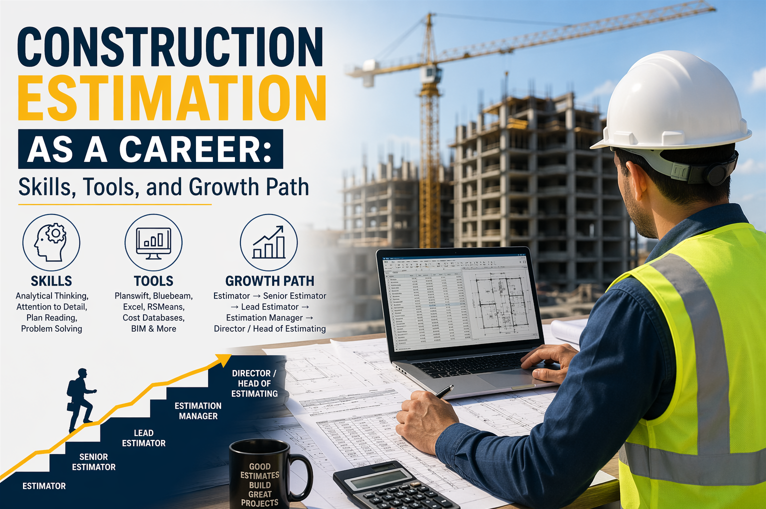
A construction estimation as a career is among the most strategic and impactful careers in the construction industry today. It concentrates on forecasting a project’s costs, assessing its viability, and helping make the right decisions before starting the work. A construction estimation job is a great way for freshers and early-career professionals to get a strong mix of technical skills, finance knowledge, and career advancement.
With the rapid growth of infrastructure development around the world, companies have become more dependent on proper cost planning and risk management. Besides, the use of digital tools, AI and data analytics has made this job even more crucial. This article aims to be your complete guide to the construction estimation career, enumerating the main skills, the use of tools, and the possibilities for career development.
Why Choose a Construction Estimation Career?
Thinking about construction estimation? You guessed it, it’s more than a numbers game! Construction estimators are literally the ones cutting the financial veins of a construction site. Their influence dictates the fate of a project, whether it gets off the ground, how it’s financially planned, and what’s on the table for risk management.
Besides, a construction estimation career can expose you to working on different types of projects, such as residential, infrastructure, and industrial developments. Estimation roles using BIM and AI-supported technologies are more innovative and data-centric than ever. Experts in construction estimation careers are among the most well-paid professionals whose work significantly affects both profitability and project success.
Average Salary and Education for Construction Estimators
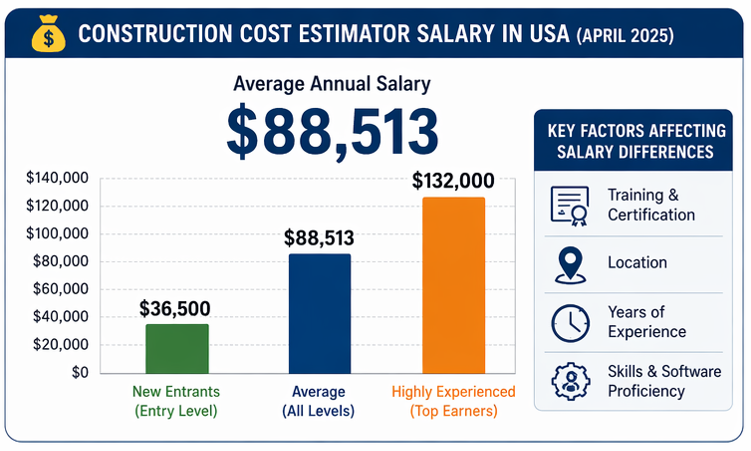
According to ZipRecruiter in April 2025, the average annual salary for construction cost estimators in the USA is around $88,513. New entrants’ salaries are at the $36,500 level, approximately, while estimators with a lot of experience have salary figures as high as $132,000. The training certification, location, and years of experience are the main factors that cause these salary differences.
Since the demand for construction continues to increase, the need for estimators is also going to be there. The career prospects are good. Those who are experts in the use of estimating software and update themselves with the new developments in the industry will find that they have more and easier access to job opportunities. Becoming certified and skill enhancement are possible ways to get better jobs that pay higher.
Generally, a candidate for the construction cost estimator position is expected to have a four-year college degree in areas such as engineering, quantity surveying, construction management, or a similar field. However, finance, business, and economics graduates are also sometimes considered by employers. It is also feasible for experienced construction workers to become estimators without obtaining a degree.
In general, it takes a total of approximately 8 years of education and work experience that are combined to qualify as a fully licensed or certified cost estimator.
Key Skills Required for a Construction Estimation Career
Those aiming to thrive in their careers as construction estimators will be expected to diversify their skills beyond just technical skills.
1. Technical Knowledge of Construction
In order to launch a construction estimation career and to be successful at it, one must first get a solid grasp of the basics of construction. Estimators have to know about construction methods, materials, as well as equipment, and the proper order of the activities. Such an understanding guides them in accurately deciphering drawings, specifications, and the requirements of the projects.
A lack of technical understanding can result in cost estimates that are either infeasible or deceptive. Besides that, it gives estimators the chance to spot potential construction problems even before the plan is made. Raising this skill through site exposure is advantageous. Ongoing learning during projects and through training is a must for remaining updated.
2. Analytical and Mathematical Skills
Working as a construction estimator involves using analytical thinking skills intensively in order to review the cost data and various project factors. This role requires estimators to deal constantly with quantities, rates, and financial forecasts.
Precision in mathematics is non-negotiable since even minor errors in the calculation can result in a significant deviation from the budget. Besides analysing, these are the skills that come in handy while comparing the alternatives and identifying the means of saving costs. Professionals will also need to logically evaluate risks, uncertainties, and contingencies with the help of these skills.
3. Communication and Negotiation Skills
One of the essential skills for a construction estimator is the ability to communicate well, as they will have to collaborate with other stakeholders continuously. Estimators not only ask questions to the architect and the engineer, but also to the supplier and contractor in order to gather and validate the information they need. Non-technical stakeholders will need to understand the cost assumptions, methodologies, and risks that you will be explaining, so your communication must be clear.
Your capability for negotiation will enable you to obtain lower prices from vendors and subcontractors. Communication, besides negotiation, is a great way for estimation and execution teams to be aligned. It reduces misunderstandings, and the projects could be better coordinated. Professional credibility and trust will be the result of this skill over time.
4. Attention to Detail
Attention to detail is really important in a construction estimation career, as the accuracy of the estimation will determine the success of the project. Estimators are responsible for going through the drawings, specifications, and contract documents thoroughly. This skill will assist you in recognising the costs, risks, and changes that have not been accounted for in the budget at an early stage.
Furthermore, it guarantees that the budgets will be well thought out and achievable. Creating the habit of thoroughly checking your work will lead to increased reliability of the estimation as a whole. Accuracy in estimation is the key to gaining stakeholders’ trust.
5. Digital and Software Proficiency
Today, a career in construction estimation requires skills in digital and software platforms. Specialists in estimating tend to utilise particular software for quantity take-offs, cost databases, and report generation. They are also expected to have skills in BIM tools, as it enables them to visualise and coordinate the different components of the project better.
Many companies are now relying on AI-based estimation tools to perform predictive analysis. Besides making the processes faster and more accurate, familiarity with software also contributes to the efficiency of the work and changes the attitude to a less time-consuming technique of performing manual calculations.
6. Risk Management Skills
Given the nature of construction projects and their heavy reliance on factors that can change without warning, risk management skills should be considered the cornerstone of a construction estimation career. Besides identifying the most common risk areas of a project (cost, time, quality of materials, and availability of labour), estimators must not only project the extent of each risk but also provide effective measures to deal with their occurrences within their estimates.
These measures ensure that the financial aspect of the projects will still be sound even when unexpected challenges come up. Finding and evaluating different scenarios is a part of risk management. Accurate risk assessment is a key factor leading to more dependable cost estimations.
7. Time Management Skills
Effective time management is a major factor in succeeding in a construction estimation career, especially if one is handling several projects at the same time. Estimators usually have to face very short deadlines in order to submit their bids or cost reports. Proper distribution of one’s time allows for all areas of estimation to be finished without quality being sacrificed.
Bad time management results in hurried calculations that could cost a lot of money because of errors. Getting help from various tools and set ways of working can also be very handy in getting more done. Without this skill, it would be difficult to keep the level of work constant, as well as hit the dates for deliverables.
8. Cost Control and Budgeting Skills
The construction estimation career is inextricably linked to the principles of cost control and budgeting. Estimators need to know the process by which budgets are made, tracked, and adjusted throughout a project. Such skill aligns estimators’ work with the project’s financial targets and limitations. Besides, it gives them the ability to recommend the measures that lead to savings in costs while maintaining the desired level of quality.
It is a must for an estimator to be familiar with the cost breakdown structures in order to be accurate in his/her work. Being good at budgeting also helps one to make the right choice, especially when it comes to procurement. Step by step, having this skill will lead one to become a financial guru when it comes to construction works.
9. Problem-Solving Skills
Problem-solving is a necessary skill for a construction estimator since different projects are bound to offer new challenges. Estimators should be able to come up with solutions when faced with issues such as a shortage of data, changes in design, or market alterations.
Besides problem-solving, evaluating alternatives and deciding the best way are also involved. Since decision-making is a major part, in that respect, its strength is the most important characteristic. This ability is what keeps the estimator still productive even when the project is changing.
10. Industry Awareness and Market Knowledge
Among the factors that lead to the success of a construction estimator are his/her ability to identify the trends of the market and knowledge of the practices of the industry. Besides the uptrend or downtrend of the economy, the professional shall be updated about material costs and labour rates.
Knowledge of the market is a necessary factor in the preparation of realistic and, at the same time, competitive estimates. Furthermore, it is the feature of market knowledge that enables one to predict price variations and the scarcity of the supply chain. Knowledge of industry standards and regulations ought to be given the same importance.
Tools and Technologies in a Construction Estimation Career
The advancement in technology has changed the construction estimation profession. Today’s estimators utilise sophisticated tools to enhance precision and teamwork. As digitalisation spreads, workers will have to consider recent tools and work methods.
1. Cost planning and quantity take-offs via estimation software.
2. Project visualisation by means of Building Information Modelling (BIM).
3. Cost analysis using AI-based tools.
4. Calculation and reporting through spreadsheets 5. Collaborative project management using integrated platforms.
Productivity enhancement and construction estimation career success largely depend on these tools.
Growth Path in a Construction Estimation Career
A career in construction estimating provides a very well-organised and lucrative career ladder for the profession. For a start, a fresher can get a job as a junior estimator where they are taught the fundamentals of quantity take-offs and cost analysis. With time and experience, the junior estimator can be promoted to the position of estimator and senior estimator, respectively.
In these jobs, they have to deal with bigger and more complicated projects. After acquiring more knowledge, the professionals have the opportunity to be lead estimators or cost managers. Besides, they also get involved in the strategic planning of the organisation. Higher up the ladder, the leadership positions, such as pre-construction manager and commercial manager, entail a certain level of thinking and decision-making.
- Entry-level: Junior Estimator, Quantity Surveyor
- Mid-level: Estimator, Senior Estimator
- Advanced: Lead Estimator, Cost Manager
- Leadership: Pre-construction Manager, Commercial Manager
Apart from just a career in construction estimating, a person is able to explore other options like project management, consultancy, and starting a business.
Conclusion
Construction estimation careers are a great way to prepare for the future, combining in this profession technical skills, analytical skills, and strategic planning in one. It is a great source of growth for those who are new or have some working experience and want to develop and adapt.
Getting the necessary skills, being competent in state-of-the-art tools, and identifying the trends in the industry – all these are the steps through which one can have a good, continuous and rewarding career. With the increasing involvement of complexity and technology in construction projects, the need for competent estimators will be on the rise. Deciding on a construction estimation profession now can be your stepping stone for long-term career success and stability.
Sources
- https://www.autodesk.com/blogs/construction/construction-estimator-career-guide/
- https://www.autodesk.com/blogs/construction/construction-estimating/
- https://www.rib-software.com/en/blogs/construction-estimator
- https://coursecareers.com/blog-posts/is-construction-estimating-a-good-career?srsltid=AfmBOorsSO3zvUHnFq09S1Hl833A-1MtQ1AfWmQOJ6ch7XXmfAFFF2No
- https://www.ziprecruiter.com/Salaries/Construction-Estimator-Salary

