


AI in construction is no longer the stuff of science fiction. It is transforming the way professionals run their daily operations. Even though autonomous bricklayers and robotic dogs have been the focus of most public discussion, the biggest changes are happening quietly in the “white-collar” sectors of preconstruction and project management. According to the latest trend reports from Autodesk, companies have outgrown the pilot stage and are now making machine learning part of their core business operations.
This change is not about substituting human skills. It is about enhancing the professional’s capacity to analyse large datasets, forecast project risks, and keep quality records. In agreement with the World Economic Forum and McKinsey, one cannot help but notice that AI in construction is the sole factor behind the new “industrialised” era in which data, and not just steel and concrete, will be the main building materials.
The End of Manual Overload: How AI in Construction Drives Efficiency
For a long time, the construction sector has found it difficult to improve its productivity consistently, with McKinsey publishing the productivity growth rate as low as 0.4% per year on average over the past 20 years. The use of AI in construction is the targeted tool for closing the productivity gap by replacing the manual and time-consuming operations that project managers often perform with automated ones.
By bringing together scattered data into a shared data environment (CDE), AI enables workers to move from being ‘data entry clerks’ to ‘data-driven decision makers’. This change is cited in Autodesk’s 2025 State of Design & Make Report, mentioning that over 76% of top executives in the industry are increasing their AI spending to deal with increasing expenses and a shortage of workers.
AI in Construction White-Collar Roles: From Hype to Workflow Reality
AI in construction white-collar working roles should be seen not as competition but as an additional feature of the existing computer programs.
Per Autodesk industry trend reports, construction teams are gradually depending on AI for:
- Analysing drawing
- Automating quantity take-off
- Streamlining document flows
The World Economic Forum (WEF) future-of-work insights points out that the roles in construction and white-collar are turning toward “data supervision” rather than “manual data processing”.
Practically, AI is embedded into:
- BIM systems
- Project management tools
- Cloud collaboration environments
Even though this change may not be very fast, the way in which decisions are being made at construction sites is radically changing. Put simply, AI in construction white-collar working roles is meant to make the tasks that require lots of information less painful. With AI tools, this “messy” information is being reorganised into clear pieces of knowledge that people can use in making decisions instead of passively processing data. The effect is not the disappearance of jobs but changing of ones where construction experts are doing less data processing and more data interpretation and decision-making.
Practical Workflows: Where AI in Construction Delivers Real Value
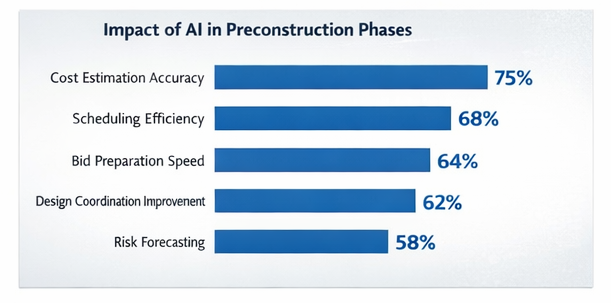
Actually, the biggest impact of AI in construction industry is the transformation of the highly precise preconstruction and management workflows, which are so critical that no compromise is allowed.
1. Precision Estimation and Takeoffs
Cost estimation in the traditional sense was a tedious manual task that was not only subjected to errors of human nature and Excel fatigue but also to some missed entries. Nowadays, AI-driven models can examine 2D plans in PDF format and 3D BIM models to carry out the entire process of takeoffs in a very short time. Actually, these machines do not merely quantify materials.
They deploy machine learning methods to check the present project specifications against thousands of records of the past, identifying the cost outliers in the process. This way, the bids are getting not just faster to generate but also very accurate, which in turn helps in maintaining the profit margins right from the start.
2. Automated Document Review and NLP
The large number of project specifications and contract documents tends to create “information silos” where important requirements get overlooked. Through Natural Language Processing (NLP) alone, AI in construction sector can “read” thousands of pages of specifications to detect the lack of submittals or contradictory clauses at a very early stage.
For instance, Autodesk’s AutoSpecs has an option to apply AI for evaluating if a project-specific set of requirements and historical standards is in accordance with the preconstruction team’s full compliance with the “golden thread” of information necessary for a successful modern delivery.
3. Dynamic Planning and Schedule Support
Project schedules are often like educated guesses colored by human optimism. AI overthrows this by launching countless “what-if” scenarios from real-world factors such as weather conditions, delays in the supply chain, and the availability of trades.
Instead of a motionless Gantt chart, planners have at their disposal predictive schedules that forecast possible blockages even weeks ahead. It gives a chance to the teams to change the use of the resources in advance in a manner which some companies claim can slash the time of the project by about 20% if combining it with the modular construction methods.
4. Proactive Risk Tracking and Analytics
Risk management has transitioned from a reactive “firefighting” mode of operation to a proactive analytical discipline. At present, AI in construction systems are analysing the project information to assign “risk scores” to different parts of the construction.
Using inputs from site cameras and wearable sensors, the white-collar safety officers have a chance to intervene even before an accident takes place. In this manner, the industry is ending up as a zero-incident one.
5. Automated QA Records and Reporting
For a long time, Quality Assurance(QA) was dependent on site walks with the team members and checklists on paper. Besides being hard to audit, these methods had a high risk of losing the document.
Currently, AI-assisted reporting tools can automatically sort site photos, associate them with specific BIM elements, and create instant progress reports for the stakeholders. This is made possible by an immutable digital twin of the project’s history, which is really helpful during the closeout process and provides owners with a thorough digital record of every bolt and nut installed.
6. Design Coordination
AI can find clashes in BIM models and pinpoint constructability problems even in the very early design phases. This could be a major factor that prevents architects, engineers, and contractors from getting tangled up in coordination delays. It notices if any fewer design conflicts are carried to the execution stages. There is a result that the handover of projects would be smoother, and there would be fewer RFIs. Besides that, AI in construction allows an automated way of comparing different design versions and identifying what has changed and how it impacts other systems.
Among the great benefits would be the reduced manual review effort, and the coordination speed across different disciplines is improved. There could be prioritisation of high-risk clashes so that teams don’t have to review every single minor conflict, but only focus on critical issues. The consequence could be more consistent design cycles and better stakeholder alignment.
AI in Quality Assurance, Compliance, and Construction Intelligence
Nowadays, the implementation of AI for professional staff in the construction industry is becoming very important in assisting quality assurance and compliance monitoring. QA workflows in the construction industry involve recording ongoing documentation, inspection tracking, and defect management. AI not only makes this easier by recognising quality issue patterns and highlighting recurrent problems automatically, but also helps to keep compliance records in a well-organised manner that is compatible with regulatory requirements.
Such AI-powered technologies can be used to study construction site pictures in order to discover defects like cracks, misalignments, or missing parts. This is a great help for manual inspections. However, over time, the system uses historical data to enhance its detection capabilities. Moreover, compliance monitoring gets simplified as the AI in construction system guarantees that all necessary paperwork is done and properly archived.
Key benefits include:
1. Speedy defect discovery through image recognition
2. Lower manual inspection load
3. Enhanced compliance monitoring and preparation for audits
4. Continuous learning from past project issues
5. Better standardisation of QA processes
Challenges, Limitations, and Workforce Transformation
Indeed, AI in construction white-collar jobs can provide great benefits. However, it is not without a few drawbacks that companies should be able to handle effectively. One of the biggest constraints is the quality of data, since the performance of AI tools is heavily dependent on the data they have been trained with. Most construction companies still have scattered or incompatible data systems. What is more, the combination with ancient instruments may be complicated and expensive.
It is important to mention a personnel transformation aspect. Instead of manual tasks, staff are required to be digitally checking the work, which means learning how to interpret data and use tools. But this does not imply fewer jobs; to the contrary, it means job reallocation. As WEF pointed out, construction labour will necessitate a person with hybrid skills who will be capable of merging technical knowledge with digital literacy skills.
On the other hand, trust is another issue. Many experts are still somewhat hesitant to use AI-based proposals for making critical decisions. Gaining trust would necessitate that AI systems reveal the modus operandi of generating insights, and there has to be continuous checking against real-world scenarios.
The Strategic Shift: Why AI in Construction is Essential for 2026
According to the World Economic Forum, AI will fundamentally transform the work landscape by 2026. It may no longer be simply a tool in the worker’s hand but will be a work redesign. A white-collar worker is expected to perform the “orchestration” of work, that is, be the one who arranges algorithmic suggestions and decides on human accountability.
1. Data Governance: In general, construction firms will be able to reap the benefits of AI only if they have qualitative and well-centralised data. Lack of good data would only render AI in construction a “costly distraction. “
2. Skill Augmentation: Besides the basic engineering skills, leaders have a strong desire for their “AI literate” workforce, who will also possess capabilities such as analytical thinking and risk interpretation.
3. Sustainable Outcomes: If you ask any company about the greatest contributor to sustainability, they are likely to say AI, as it not only helps in the design phase but also calculates the carbon footprint of different materials.
4. Reduced Burnout: By transforming the repetitive report-making process, AI frees up employees, so their time is spent on problem-solving of high-value, turning into high engagement level.
Final Thoughts
Building automation through AI in construction is a big change in the human role after the introduction of CAD in the design process. Going beyond “hype, the focus has been shifted to practical application in estimation, risk tracking, and document review. Hence, the industry has reached the digital maturity required for the modern age. As companies gear up for the AI-first period, those professionals who use these tools for enhancing their judgment, rather than substituting their judgment, will be the ones who thrive.
Sources
https://kodifly.com/the-next-normal-in-construction-insights-from-mckinsey-s-report
https://www.autodesk.com/blogs/construction/ai-construction

