

There are substantial changes taking place in the construction industry owing to the introduction of artificial intelligence, as there are smart ways of doing things, which are not only effective but also faster than other methods. AI helps organizations to optimize their processes and reduce costs while improving safety levels across all phases of the operation. As the industry becomes more intricate, the use of artificial intelligence is no longer a matter of choice but a matter of necessity.
Understanding Artificial Intelligence
Artificial intelligence, or AI, is a term used to describe a high-level technology built to mimic human intelligence in analyzing large volumes of data, identifying patterns, and creating meaningful interpretations.
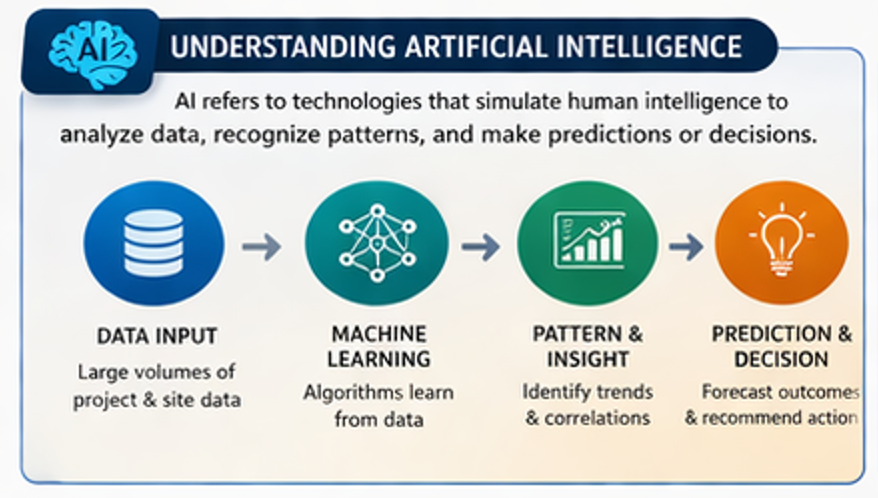
AI systems equipped with machine learning can forecast results, suggest enhancements, and even make decisions. These features of artificial intelligence, based on data analytics, are becoming a significant aid to the construction industry at all stages of the project.
Role of AI in Construction Phases
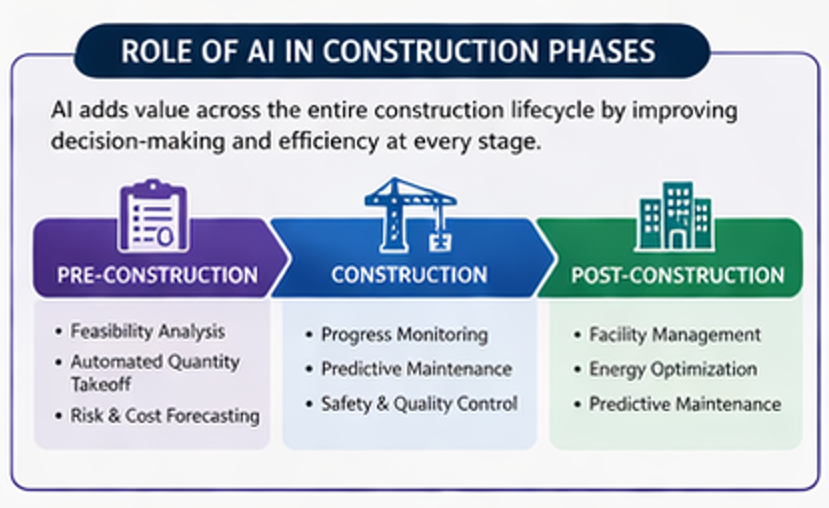
In this regard, AI can be useful throughout the construction process, whether it is before construction, during construction, or after construction maintenance. Companies take advantage of the computing and forecasting abilities of AI to improve their design, construction, and maintenance efforts. To illustrate, while an AI chatbot can assist a company in saving five minutes on a mundane task, AI forecasting can help reduce costs by $5 million with appropriate scheduling changes.
Adoption has been gradual in the past due to several reasons. One reason is that construction projects involve many participants, experts, and suppliers. Therefore, the integration of any new technology can be quite complicated. The organizational preparedness for implementing AI can be evaluated based on the firm’s capacity to finance the deployment of new technology, management and employee skills, and innovative spirit.
Currently, construction and engineering firms are exploring opportunities to use AI technology in controlling increasing costs, predicting supply chain disruptions, sourcing skilled workers, and increasing efficiency.
Key Advantages of AI in Construction
Let’s look into some of the advantages of AI in construction:
1. Safer Work Environments
With the help of machine learning and a substantial amount of data from equipment and site conditions, the work environment inside a construction site can be made safer. For instance, computer vision techniques can be applied to continuously monitor video streams in order to identify potential unsafe behaviors like the misuse of personal protective equipment, which subsequently leads to human casualties. Thus, it is possible to prevent such accidents step by step.
2. Smarter Planning and Design
Planning with AI and computer assistance, first of all, significantly speeds up the process, as the evaluation of different project scenarios can be done simultaneously. Other benefits include designing one or more alternatives based on the lowest cost, highest performance, and other building green standards and requirements. Besides, it is also possible to incorporate information on the technical systems (for example, electrical and plumbing), which will lead to a much better precision of the design.
3. Better Cost Management
With the changing variables in the scene, a traditional cost estimation method can be challenged in an ever-dynamic environment. AI, on the other hand, leverages past and current data to make cost estimates. The overall spend, both in terms of real-time and historical, can be tracked by the system, which can inform necessary change (budget control), and hence, effective adjustments can be made in time.
4. Higher Productivity
Because of automation, one can forego hours of performing monotonous manual tasks, for example, looking for suitable materials and creating a schedule. AI can step up the game even further by identifying what share of labor and equipment is optimal given a particular set of inputs and constraints. In the case of breakdowns leading to natural wear and tear, AI can forecast the maintenance needs, thus supporting production by eliminating downtime.
5. Improving Quality Assurance
The AI system can assist the architect in analyzing the design and finding any flaws that may exist prior to the construction process. During the construction process, robotics and sensors are employed in order to perform highly precise operations such as welding, laying bricks, and so on.
6. Anticipative Equipment Maintenance
Machines with sensor systems constantly send their performance data to AI platforms, which can identify the very first signs of damage or breakdown. Teams are then able to carry out repairs beforehand, thus avoiding unexpected interruptions and expenses.
7. Increased Energy Efficiency
AI programs analyze variables such as weather, building architecture, and occupancy to help control energy use. Besides, it has the capability to fine-tune HVAC systems in real-time, which ultimately leads to lessening the supplier costs as well as saving the environment.
8. Better Project Management
AI serves as an excellent support system for project managers when they prepare a schedule and plan their resources by generating project schedules swiftly and pointing out any possible delays. AI may prove helpful in determining the exact way equipment, labor, or materials should be assigned without wasting anything. And when it comes to budgeting, AI flags possible cost overruns by spotting tricky project areas or technical roadblocks ahead of time.
9. Superior Data Insights
Construction experts, with the support of AI-powered analysis, will be able to better understand the costs, duration, and success rates of their projects. This information gives them an upper hand as far as making decisions is concerned.
10. Sustainability Innovations
One way that AI can promote environmentally friendly construction is through the reduction of material waste and the increase of efficiency in resource use. In addition to this, it may help in making buildings with longer life spans, and the implementation of green materials could be done in a more efficient way.
Practical Applications of AI in the Construction Industry
The AI technology is currently utilized in all phases of construction firms’ work, including pre-construction, construction, and post-construction maintenance. Improving the speed and insightfulness of data analysis is the main factor that ties together these three phases.
1. Pre-construction
Using AI algorithms during project pre-construction would be highly beneficial. There are many activities associated with project preparation that can be facilitated using artificial intelligence. AI can be used to carry out further analysis on financial, marketing, and environmental factors to determine whether or not the project is feasible, among other applications. Moreover, AI can assess material quality and longevity and assist the project team in determining the most appropriate material option.
With image recognition technologies offered by AI, it becomes possible to analyze images developed by engineers, which show how many windows, doors, and walls there are in the project and what costs should be associated with them. Before, this process was rather complicated and involved many mistakes since the calculations were carried out manually. Although project managers need to verify every prediction that the technology makes, it is highly dependable, although not perfect.
2. Construction
Predictive analytics using AI during the construction process will enable construction teams to predict any issues that could arise from delays in supply chains, thus preventing potential problems. Using AI-powered maintenance tools, equipment breakdown is predicted beforehand, hence saving the team time due to less downtime.
In addition to taking aerial shots, drones equipped with AI have a wide array of roles. For instance, it will be easier to identify any risks associated with the construction project. Project status updates become easier while keeping within budget and meeting the deadline. AI algorithms analyze BIM models to determine how work should be sequenced. And when everyone is plugged into a central project platform, AI serves up useful data right when it’s needed, making collaboration and communication a whole lot easier.
3. Postconstruction
Using artificial intelligence to foresee future maintenance needs means that the construction workers can be prepared in advance for the machinery used at the site. This guarantees that all possible issues are identified at an early stage and enables one to prepare for them. The software runs continuously. Consumption of energy is monitored constantly, from whatever it may be, whether it is heating, lighting, or elevators, and provides instant advice on how to minimize expenses and carbon footprints. Once the job is completed, the artificial intelligence evaluates the whole process to make improvements for the future.
AI in Construction: Challenges & Opportunities
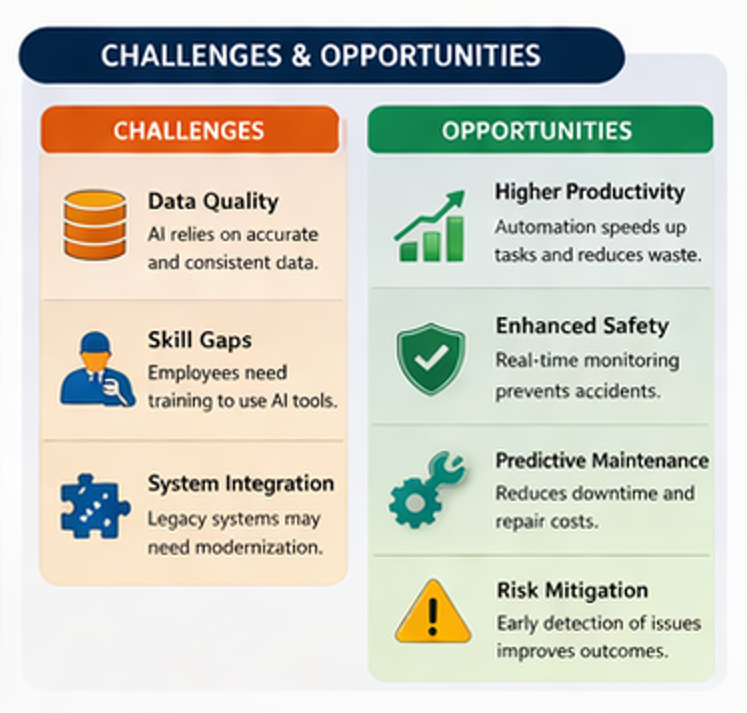
Although AI brings a lot of advantages, organizations have to deal with various issues related to the quality of data, skill set gaps, and integration with legacy IT systems. If implemented properly, AI provides better productivity, predictive maintenance, and decreased risks associated with projects.
- Data Quality: AI algorithms depend on good-quality data
- Skill Gaps: Employees should learn how to work with AI software tools
- System Integration: Organizations may need to modernize legacy systems.
Despite those concerns, there are some chances for organizations in terms of productivity increase, enhanced safety, predictive maintenance, and risk mitigation.
Future of AI in Construction
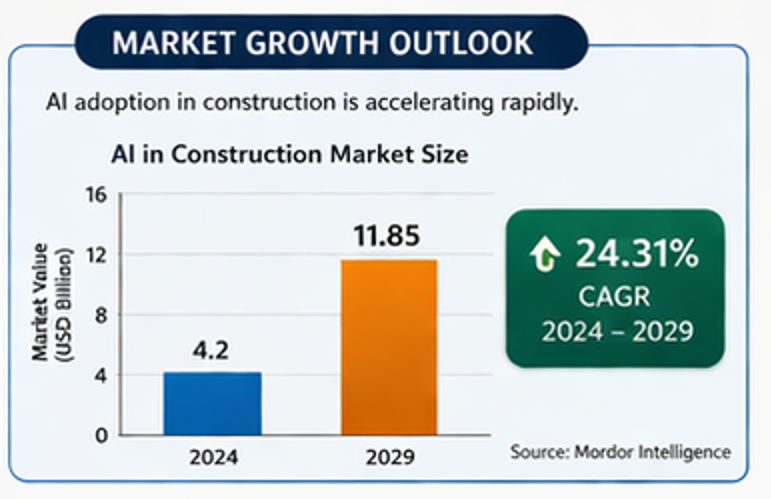
AI in the construction market is forecasted to reach an overall market value of US$11.85 billion by 2029 at a compound annual growth rate of 24.31%, as stated by Mordor Intelligence. It is anticipated that there would be various improvements in the construction process due to artificial intelligence. Such improvements include planning and design, project scheduling, resource management, worker safety, energy efficiency, sustainability, and many other aspects.
For example, as AI technology continues to advance in BIM software, project teams will have better opportunities to exploit the advantages of visualization in the construction process. Robotics would enable the utilization of autonomous equipment to ensure efficiency and safety on the job site. While robotics can alleviate the issue of labor shortages, industry experts believe that they will complement rather than substitute human expertise. Expect AI technology to be embedded into construction software programs to help managers and workers perform tasks without requiring any knowledge of AI.
Final Thoughts
Real-life implementation of artificial intelligence in construction cannot be done with just one technology. It needs an engineering-driven approach where AI is incorporated into all the other technologies used. This can be accomplished through the implementation of AI technologies that incorporate all three phases into one seamless process. This is especially important in today’s world as the construction industry advances. Without a holistic approach to AI, it may become difficult for firms to compete.

