

The Indian construction industry contributes significantly to the economy and creates a lot of jobs for many people. Due to fast-growing urban areas, expanding infrastructure projects, and Smart City initiatives from the government, there is huge potential in the construction industry.
However, it also faces many challenges in construction industry in India, such as a labour shortage, skilled labour shortages, increased cost, and technological advances. These issues need to be understood by professionals who want to further their careers, as well as companies that are looking for growth within the construction industry.
Growth Snapshot and Top-Performing States in Indian Construction
Construction is a highly regarded sector and holds a prominent place within Indian society and its economy due to the large public and private investments made into it. Rapid growth through engineering advancements has allowed many major implementations to be completed, thus creating needed infrastructure. By 2030, the sector is expected to contribute 15% of India’s GDP and employ over 70 million people.
As per Next Move Strategy Consulting, the Indian construction industry revenue base was $884.72 Billion in 2023. It is expected to reach $2,134.43 Billion by 2030 at an annual rate of 12.6% from 2024-2030. This growth makes India one of the five largest construction industries in the world – competing alongside China, the USA, the UK and Indonesia.
Key Drivers of Growth in the Construction Industry
- Investment in Infrastructure by Government: USD 1.4 trillion is allocated to the National Investment Pipeline (NIP) for the construction of renewable energy, highways, railways & development of urban areas.
- Urban Growth: Urbanization will account for 50% of the overall Indian population by the end of 2046, requiring the construction of housing, office buildings, and access to urban transportation.
- Uses of Public Transit and Metro: India has the 3rd largest metro network in the world and serves 10 million daily customers, creating a larger need to develop urban area construction.
- Funding for Investment by Government: Urban Infrastructure Development Fund (UIDF) funds USD 1.2 billion per year for urban infrastructure development in Tier II and Tier III Cities.
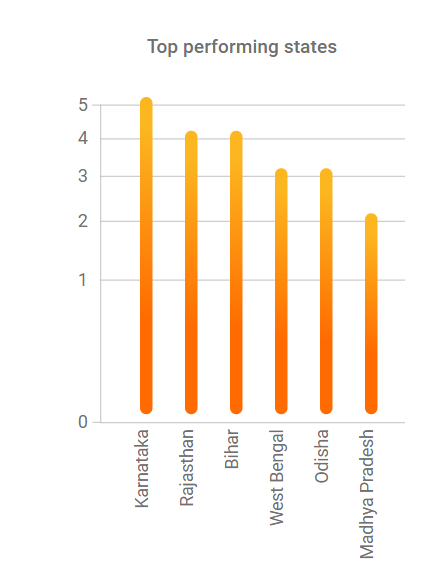
Top Performing States Contributing to the Expanding Indian Construction Industry
Key Challenges in Construction Industry in India
The construction industry in India has been growing steadily, but it still faces several challenges.
1. Labour Shortages and Skill Gaps
The construction sector in India employs a total of almost 32 million people (per CIDC data). However, there is still a large segment of the workforce that is untrained, or at best, semiskilled, resulting in a constant scarcity of available labour. One of the causes of the skilled worker shortage is the natural tendency of workers to move from rural to urban areas as a result of migration trends and limited vocational training options available to them. The presence of too few skilled labourers results in reduced productivity and delayed completion of jobs, both of which negatively impact project completion timelines and ultimately increase costs on job sites nationwide.
In addition, there are insufficient amounts of regular training programs for employees, a high turnover rate among employees, and a lack of adequate skill development initiatives for rural employees, which are also contributing to this problem. Technology-based systems for construction (like Building Information Modelling (BIM), drones, and artificial intelligence) require well-trained individuals who are qualified to use them. However, the gap in demand vs. supply continues to cause inefficiencies throughout our industry and makes it difficult to maintain the level of quality expected from the industry and to fully implement advanced technologies into their operations.
2. Cost Overruns and Financial Constraints
The construction industry in India is facing two of its greatest challenges. Rapid infrastructure expansion via the National Infrastructure Pipeline and Smart Cities Mission has continued to place a financial burden on budgets that are becoming increasingly pressed as well. As of May 2024, 458 major construction projects were reporting budget overruns of ₹5.71 crore each, which is 20.7% higher than their initial budget estimates. The main reasons for the amount of budget overruns can be attributed to poor estimating methods (inaccurate cost estimation), the type of project scope changes, inflation and timeliness in resolving land acquisition.
Some sectors have experienced cost increases well into the hundreds of percentages, with the Indian Railways operating 54% above budget, while water resource projects are 200% over. The financial strain that is being experienced by construction companies is affecting their ability to fund other projects and creating risks to the overall economy. Effective budget management and cost containment must occur to address the issues faced by the construction industry in India.
3. Rising Raw Material Costs
The construction industry in India is facing rising raw material prices as a key problem. Around the world, steel, cement, and bitumen prices have seen a considerable price increase. For example, TMT steel in Coimbatore increased by 20% in one month in 2026, with a price relative to the prior months of ₹10 to ₹12 per kg – a substantial impact on the cost of construction. These cost increases place an increased financial burden on contractors and lead to delays in completing projects, subsequently decreasing the profitability of the contractors.
Additionally, public sector projects for railways, highways, and urban transport are suffering from increased pressure from rising material costs. Since a large percentage of total project outlays consist of material costs, it will be important to properly manage procurement processes, monitor costs and investigate alternative materials. This will go a long way to help the construction industry address the challenges it faces currently and in preventing future project budget overs and delays.
4. Safety and Health Risks
The construction industry in India has serious issues concerning health and safety, primarily due to the high risk of injury associated with working independently or within an insecure work environment, as well as the limited number of those responsible for ensuring compliance with health and safety legislation throughout the country. Therefore, construction workers’ exposure to major risks is frequent and, for some, unavoidable, such as falls from height or machinery-related accidents, and potential long-term illness resulting from inhalation exposure to dust.
The construction industry represents a significant portion of all industrial-related deaths in India. Construction workers are impacted by respiratory illnesses and heat stress as a result of the presence of high particulate matter, humidity, and temperature levels. There is a requirement for further regulation, better training and the use of modern work practices to help address the challenges construction workers face in India.
5. Regulatory and Compliance Challenges
Regulatory and compliance issues are major challenges in construction industry in India that have caused delays and increased costs. Construction projects need to deal with a complicated approval system that requires multiple approvals from many different authorities, including land acquisition, environmental clearances and permits. The long processes to complete the approval steps and inefficient bureaucracy delay the start of construction on projects, with most projects facing a delay of several months to years before the project starts.
The central government frequently changes their policies. However, state agencies have no way of knowing how to comply with them. Because there are so many changes to policies, developers are also continuing to adapt to the new policies at the same time that developers continue to comply with prior policies. As developers continue to have to adapt to new regulations, they also continue to have to adjust their timelines for completion of their construction projects and continue to have to adjust their construction project costs due to adapting to the change in regulations. The unpredictability of the amount of time it will take to secure approvals and comply with the new regulations on a construction project reduces the level of confidence that the investors will have in a construction project.
6. Technology Adoption
Adoption rates in India’s construction sector tend to fall short relative to the demands created by continuing growth in demand for new construction services and products. The slow pace of adoption for digital technologies such as project management software and real-time communication tools negatively impacts the coordination of all construction operations, as well as the safety of those operations. Due to the size, diversity, and complexity of projects, many contractors have not had sufficient resources to learn about new technologies.
Nguyen and Tran (2015) and Thompson and Richards (2020) have shown that the lack of institutional support for subcontractors creates a significant gap between innovation and policy, preventing the transformation of the construction industry. This mismatch impedes the industry’s ability to address broader challenges within the construction industry in India and remain competitive with the rest of the world.
Careers in the Indian Construction Industry
The Indian construction sector presents many diverse job possibilities for its people, notwithstanding its difficulties.
1. Engineer and Project Management
- Engineers, including civil, structural and mechanical, have an essential responsibility in the design and execution of facilities.
- Project managers (PMs) manage the work of all those who accomplish it as well as the budget and timing of the project.
- PMs must be proficient in planning, risk management, and application of Building Information Modelling (BIM), and should possess good people skills to supervise and lead those who comprise the team.
2. Technicians and Skilled Trades
- High demand for Electricians, Masonry Workers, Carpenters, Welders & Heavy Equipment Operators.
- The demand for electricians, masons, carpenters, welders, and heavy machinery operators/technicians has continued to remain high.
- Vocational training programs have been put in place to help fill the skill gap so that new employees can find work.
- A large number of companies have developed training programs to Train Employees on Modern Construction Technologies.
3. Emerging Tech Careers
- There is also a growing demand for technology professionals who specialize in working with digitally constructed environments, like drones and Building Information Modelling (BIM).
- Enhanced AI and IoT tools are also creating new career options for individuals employed in predictive maintenance, project status tracking, and automation.
4. Environmental & Safety Careers
- Environmental engineer, safety officer and sustainability consultant will ensure that compliance occurs with the laws that are currently enacted and the building code on green building.
- As ESG initiatives continue to develop in the construction field, this provides a unique opportunity to enter and grow within the industry.
Final Words
The rapidly developing Indian construction industry presents many job opportunities, but at the same time has major challenges, such as a lack of available skilled workers, rising costs caused by unpredictable market conditions, and not all companies using the most up-to-date technologies. Those companies and professionals who can adapt to the challenges of the construction industry in India by improving their skills, adopting new technologies, and developing a good strategic plan can overcome challenges in the construction industry and have an advantage in the growing construction market in India.
Sources
- https://www.mordorintelligence.com/industry-reports/india-construction-market
- chrome-extension://efaidnbmnnnibpcajpcglclefindmkaj/https://isid.org.in/wp-content/uploads/2025/04/WP297.pdf
- https://indiainvestmentgrid.gov.in/sectors/construction
- chrome-extension://efaidnbmnnnibpcajpcglclefindmkaj/https://www.ijrar.org/papers/IJRAR19D2656.pdf
- chrome-extension://efaidnbmnnnibpcajpcglclefindmkaj/https://www.jetir.org/papers/JETIR2504165.pdf
- chrome-extension://efaidnbmnnnibpcajpcglclefindmkaj/https://www.iitk.ac.in/nicee/RP/2004_Challenges_Construction_Industry_Proceedings.pdf
- chrome-extension://efaidnbmnnnibpcajpcglclefindmkaj/https://www.ijcrt.org/papers/IJCRT2508391.pdf
- https://timesofindia.indiatimes.com/city/coimbatore/20-rise-in-steel-prices-likely-to-slow-down-construction-activity/articleshow/128728821.cms?utm

