

Description

Generative AI (GAI) refers to systems that can produce human-like text, images, audio, video, and even code. While it unlocks creativity, productivity, and innovation, it also raises profound ethical challenges.
What you’ll learn
| 1️⃣ Identify and explain the potential benefits and drawbacks of Generative AI across various applications. | 3️⃣ Evaluate the ethical implications of deepfakes, a product of Generative AI and articulate best practices for responsible use and detection. |
| 2️⃣ Discuss the data privacy and security concerns associated with Generative AI development and deployment. | 4️⃣ Apply frameworks for responsible development and deployment of Generative AI in a real-world context. |
Who Should Enroll:
- BDevelopers & Programmers: Working with LLMs to create applications, you’ll gain the knowledge to mitigate bias, ensure data privacy, and build trust with users.
- Business Professionals: Integrating LLMs into marketing, customer service, or content creation? Learn how to leverage their power ethically and responsibly.
- Policymakers & Legislators: Shaping the future of AI requires an understanding of ethical considerations. This course equips you to create future-proof regulations.
- Educators & Researchers: Developing the next generation of AI? Learn how to promote ethical practices within your field.
- Content Creators & Writers: Exploring the use of LLMs for content generation? This course will help you navigate issues of authorship, plagiarism, and responsible use.
- Journalists & Media Professionals: Combating misinformation and deepfakes is crucial. Gain the knowledge to identify potential issues and ensure ethical reporting.
Explore related topics
- AI ETHICS AND GOVERNANCE
- OTHER BUSINESS
- BUSINESS
This course includes:
| 👨👩👧👦 Role Play |
| 🖥️ Access on mobile and TV |
| ⏯️ 2 hours on-demand video |
| 📖 Certificate of completion |
| 🌐 1 article |
| 💎 Premium | Access this top-rated course, plus 26,000+ more top-rated courses, with a Udemy plan. See Plans & Pricing | 4.5 ⭐⭐⭐⭐⭐ 5,690 ratings | 👥 16,634 learners |
Instructor

Steve Ballinger, MBA
Millionaire Investor|Stocks|ChatGPT|Mgmt. Teaching 970,000+
🌟 4.5 Instructor Rating
🏅 257,235 Reviews
👩👩👦 980,850 Students
📊 87 Courses
Three Pillars:
1. Provide learning that is of tremendous value with complete courses with tips, tactics, and tools, that can be applied immediately.
2. Leverage personal success as a regular person who built a million dollar plus investing portfolio and lives daily what is taught. If Steve can do it so can you.
3. Great teaching experience as a former Director of Global Training in the business world and as an Adjunct University Professor. Not only expertise but can teach it to help you. Core belief is helping others to succeed.
Key Findings
Eighty-two percent of respondents care about the ethics of AI.
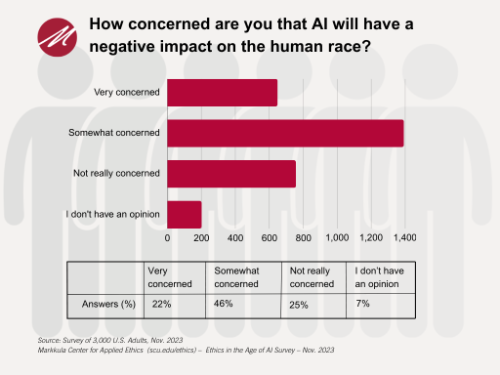
How concerned are you that AI will have a negative impact on the human race?
A1 Very concerned 22%
A2 Somewhat concerned 46%
A3 Not really concerned 25%
A4 I don’t have an opinion 7%
Sixty-eight percent of respondents are somewhat or very concerned about the negative impact of AI on the human race, compared to one in four who are unconcerned.
86%
Eighty-six percent of those surveyed believe AI companies should be regulated.
83%
Eighty-three percent of respondents believe the government should create clearer AI regulations.
55%
Over half (55%) of those surveyed believe AI companies are not considering ethics when developing AI.
Eighty-six percent of those surveyed believe AI companies should be regulated.
Should the technology companies developing AI be regulated?
A1 Yes 86%
A2 No 14%
In one of the strongest results of the survey, about 6 out of 7 of those polled agree that companies developing AI should be regulated.
Eight in 10 respondents believe the government should create clearer AI regulations.
Do you think the federal government should create clearer regulations around the development and use of AI?
A1 Yes 83%
A2 No 17%
In one of the clearest results in the survey, more than four in five of those surveyed think that the federal government should have a role in creating clearer regulations around AI.
Over half (55%) of those surveyed believe AI companies are not considering ethics when developing AI.
Do you think the companies developing AI are considering ethics while designing the technology?
A1 Yes 45%
A2 No 55%
Those polled show their skepticism towards ethical thinking in AI companies. While many companies developing AI do have people thinking about ethics.
Just over half don’t trust AI companies.
Do you trust the companies that are creating AI?
A1 Yes, completely 8%
A2 Somewhat 41%
A3 Not really 38%
A4 Absolutely not 13%
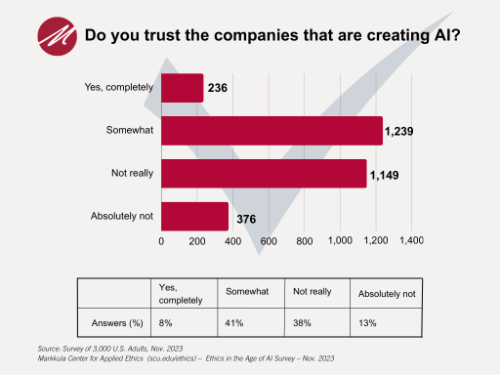
This question divided those surveyed almost evenly, with 49% of those polled trusting AI companies somewhat or completely, and 51% not really or absolutely not trusting AI companies.
Seventy percent of those surveyed believe AI companies should take a break to consider safety.
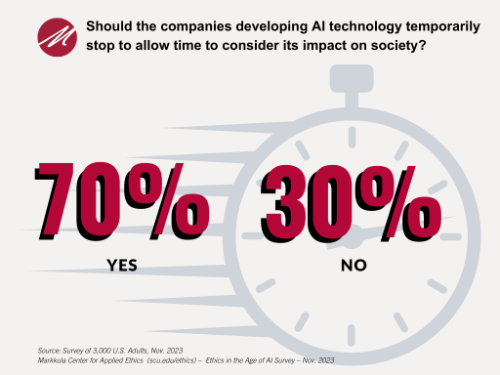
Should the companies developing AI technology temporarily stop to allow time to consider its impact on society?
A1 Yes 70%
A2 No 30%
Interestingly, and in alignment with the Future of Life Institute’s letter calling

